

- Joined
- Oct 1, 2004
- Messages
- 2,864
- Age
- 43
- Location
- Oklahoma
- Main Job

- Secondary Job

- Third Job

- Server
- Quetzalcoatl
- Linkshell
- RoyalKnights
- FFXIV
- Celvantes
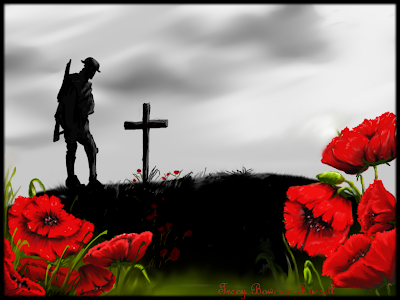
Written by a co-worker:[SIZE=+1]In Flanders Fields the poppies blow[/SIZE]
[SIZE=+1]Between the crosses row on row,[/SIZE]
[SIZE=+1]That mark our place; and in the sky[/SIZE]
[SIZE=+1]The larks, still bravely singing, fly[/SIZE]
[SIZE=+1]Scarce heard amid the guns below.[/SIZE]
[SIZE=+1]We are the Dead. Short days ago[/SIZE]
[SIZE=+1]We lived, felt dawn, saw sunset glow,[/SIZE]
[SIZE=+1]Loved and were loved, and now we lie[/SIZE]
[SIZE=+1]In Flanders fields.[/SIZE]
[SIZE=+1]Take up our quarrel with the foe:[/SIZE]
[SIZE=+1]To you from failing hands we throw[/SIZE]
[SIZE=+1]The torch; be yours to hold it high.[/SIZE]
[SIZE=+1]If ye break faith with us who die[/SIZE]
[SIZE=+1]We shall not sleep, though poppies grow[/SIZE]
[SIZE=+1]In Flanders fields.[/SIZE]
To all the brave soldiers, sailors, airmen, and Marines... past, present, and future:Each November, Poppies blossom on the lapels and collars of over half of Canada’s entire population. Since 1921, the Poppy has stood as a symbol of Remembrance, our visual pledge to never forget all those Canadians who have fallen in war and military operations. The Poppy also stands internationally as a “symbol of collective reminiscence”, as other countries have also adopted its image to honour those who have paid the ultimate sacrifice.
This significance of the Poppy can be traced to international origins.
The association of the Poppy to those who had been killed in war has existed since the Napoleonic Wars in the 19th century, over 110 years before being adopted in Canada. There exists a record from that time of how thickly Poppies grew over the graves of soldiers in the area of Flanders, France. This early connection between the Poppy and battlefield deaths described how fields that were barren before the battles exploded with the blood-red flowers after the fighting ended.
Just prior to the First World War, few Poppies grew in Flanders. During the
tremendous bombardments of that war, the chalk soils became rich in lime
from rubble, allowing “popaver rhoes” to thrive. When the war ended, the
lime was quickly absorbed and the Poppy began to disappear again.
The person who was responsible more than any other for the adoption of the Poppy as a symbol of Remembrance in Canada and the Commonwealth was Lieutenant-Colonel John McCrae, a Canadian Medical Officer during the First World War. The poem he wrote is still to this date recited at each and every Remembrance Day ceremony and school in Canada on November 11th.
A meaningful and peaceful Veteran's Day.




