
You are using an out of date browser. It may not display this or other websites correctly.
You should upgrade or use an alternative browser.
You should upgrade or use an alternative browser.

- Joined
- Aug 18, 2004
- Messages
- 906
- Location
- California
- Main Job

- Secondary Job

- Linkshell
- PhonicusBananicus
It could happen, but we will have to wait and see.
- Joined
- Dec 4, 2007
- Messages
- 198
- Main Job

- Linkshell
- UnknownSoldiers
- FFXI
- Whimsey
ok everyone this is what we need to do, we need to grab 3 shovels, a spoon and a giant magnet... were going to REVERSE mother nature.. and kick her in the balls and say FUCK YOU and your cycles!ready get set... GO GO GO!

That's right! Take that, bitch! Bow to the superiority of the opposable thumb! Wait . . . what are the shovels for?
- Joined
- Aug 18, 2004
- Messages
- 906
- Location
- California
- Main Job
- Secondary Job
- Linkshell
- PhonicusBananicus
If Mother Nature had balls, I would drop my shovel my and run.

- Joined
- Aug 10, 2004
- Messages
- 10,285
- Age
- 39
- Location
- Sweden
- Nation Banner

- Main Job
- Secondary Job

- Third Job
- Server
- Fenrir
- Linkshell
- Avaritas
- FFXIV
- Uzor
The seas under the polar ice on Antarctica (yes, there are water that is not frozen under the ice) actually contains 1/3 of all the water in all of the seas in the world. One of the largest subglacial seas, Lake Vostok, which isno less than 250 km long, 50 km wide and up to 400 meters deep, covers an area of 15,690 km², and is thus similar in size to that of Lake Ontario. And this is just one of the over 140 subglacial seas found on Antarctica. This lake alone contains an estimate of 5,400 km³ water. The scary part, is that due to the glacier's pressure on the water, the water sometimes escape, and create rivers, that can not only run down hill, but also up hill. Thus, entire seas can empty themselves and escape to another sea close by, or even in to the ocean, and thus result in a change of the ocean currents.
As if this wasn't enough, the seas under the polar ice accelerate the ice mantle's movement from 2-3 m/year up to 50 m/year when the polar ice moves over it, as the water decreases the friction to almost 0. This allows the ice to move out to the ocean faster, and due to the global warming, the ice shelves will smelt faster when they reach the ocean. As the polar ice contains 90% of all the fresh water in the world,
the sea level would rise by up to 70%, assuming all of the polar ice smelted. However, this has not happened even once in the past 15 million years, so odds are on our side for that at least.
However, that is not a reason to relax. The ocean currents play a very important role for our climate.
Did you know: When salt water meets Fresh Water, the salt water pulls the fresh water in order to equal out the balance of salt. The pressure temporarily created is estimated to be the pressure of a 270m tall waterpillar. For every meter below the sea level you travel, the pressure is increases. At sea level, the pressure is one atmosphere. At one meter below sea level, it is two atmospheres. At the bottom of the 270m pillar of water, the pressure would be 271 atmospheres. This effect is called Osmosis, and is widely used in the nature. A good example is cells. However, humans can put this to good use as well, by creating salt power. Globally, salt water power could provide the world with 1600 TWh per year. While it is small in comparison to the world's total energy usage (USA use roughly 29000 TWh per year), it is still a step in the right direction, and it is still in its early productions.
However, salt power stations also have another usage; the water coming out of the power plant is actually cleaner then the water it takes in, as the water needs to be cleaned before entering the power station, as the equipment is easily ruined by dirt.
If the planet were to change its tilt, we would be in for a fuck load more problems then a simple magnetic pole switch. That would seriously result in the end of the world as we know it, as it would result in the polar ices possibly completely smelting, raising the sea level by 70 meters, creating an uncontrollable amount of floods and people dieing, as well as a lack of food and water for people that live more then 70 meters above the sea level. It would result in possibly over 90% of all the living beings living above the sea level in the world going extinct, as well as a lot of sea creatures going extinct. Basically, it would create chaos, not only for humans, but for everyone.
Just look at Mars. Its axis changes all the time, and it is unlivable. One of the reasons Earth is livable could be because we have an axis that don't change by a lot. Earth's axis varies between 22,1 and 24,5 back and forth over a period of 41000 year period between each high and low, while Mars's axis varies between 15 and 35 degrees over a period of 125000 years. Partly because we have a large moon, while Mars have two small. For as long as we have our moon, our axis tilt won't change by a lot. However, our moon moves away from us at a rate of, if I remember right, 1cm per year, and the further away it is from us, the more it allows Earth to tilt.
As for the Ice Age, the amount of Greenhouse gasses have always naturally varied. This is what annoys me, as scientists and so-called experts seem to have taken a likening to blaming everything on us humans. Look at these graphs for example, I will explain why I show them later:
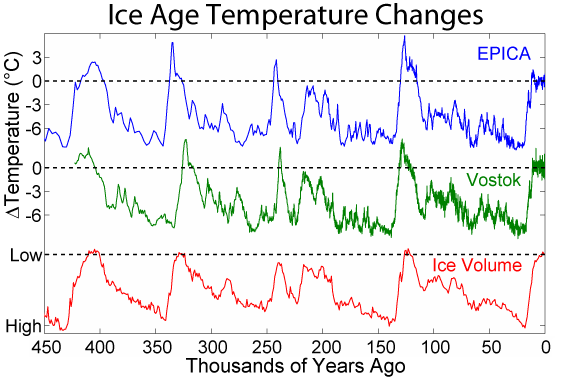

Unless humans were in the industrial age 400k years ago, you can't blame everything on us Humans.
As for the first image. As you can see, the temperature is higher the less ice exists on earth. This is natural, as ice reflect sunlight better then liquid water. This means more sun energy is reflected, and allows the earth to "absorb" less heat. Thus, the less ice that exist on the ground, the lower the average temperature of the earth is. As we're currently in an interglacial period (this means the ice is retreating), the ice in the poles smelt. And as I said earlier, the less ice that exists, the less of the sun's energy is reflected, meaning the average temperature on earth increases. This is exactly what is happening right now, so everything can't be blamed on us humans, as this is a natural side effect of an interglacial period.
This is also what allows a "snowball" effect, resulting in a majority of the earth being covered in ice. When an Ice Age begins, the ice glaciers start traveling towards the equator. This causes more sun energy to be reflected, lowering the average temperature of the earth, resulting in the ice age snowballing, as more areas get colder, resulting in more snow, resulting in an even COLDER earth due to snow reflection, resulting in more snow etc. etc. Its a natural cycle the earth goes through.
That being said, as I said earlier, that is not a reason to relax, as the amount of greenhouse gasses in the atmosphere speed the process up, which could result in either the process speeding up, or breaking the Earth's the natural cycle, by, say, smelting ALL of the glacial ice, which likely has not happened since the birth of earth.
In conclusion, you shouldn't panic, but you should still think about environmental health.
As if this wasn't enough, the seas under the polar ice accelerate the ice mantle's movement from 2-3 m/year up to 50 m/year when the polar ice moves over it, as the water decreases the friction to almost 0. This allows the ice to move out to the ocean faster, and due to the global warming, the ice shelves will smelt faster when they reach the ocean. As the polar ice contains 90% of all the fresh water in the world,
the sea level would rise by up to 70%, assuming all of the polar ice smelted. However, this has not happened even once in the past 15 million years, so odds are on our side for that at least.
However, that is not a reason to relax. The ocean currents play a very important role for our climate.
Did you know: When salt water meets Fresh Water, the salt water pulls the fresh water in order to equal out the balance of salt. The pressure temporarily created is estimated to be the pressure of a 270m tall waterpillar. For every meter below the sea level you travel, the pressure is increases. At sea level, the pressure is one atmosphere. At one meter below sea level, it is two atmospheres. At the bottom of the 270m pillar of water, the pressure would be 271 atmospheres. This effect is called Osmosis, and is widely used in the nature. A good example is cells. However, humans can put this to good use as well, by creating salt power. Globally, salt water power could provide the world with 1600 TWh per year. While it is small in comparison to the world's total energy usage (USA use roughly 29000 TWh per year), it is still a step in the right direction, and it is still in its early productions.
However, salt power stations also have another usage; the water coming out of the power plant is actually cleaner then the water it takes in, as the water needs to be cleaned before entering the power station, as the equipment is easily ruined by dirt.
Ironically, the middle east has started to prepare for an oil shortage. Saudi-Arabia, which is the world's largest producer of oil, has for example started to invest in biomass fuel, by planting Jatropha. Jatropha is a bush whose fruit can produce up to 40% oil, which can replace normal oil to run a diesel motor. India, for example, have planted 173 million hectares of this plant. One hectare of this plant create 1600 liters of oil. India thus produce 276800000000 liter of organic oil. However, that isn't all. As this plant likes dry areas where you can't grow food, this bush won't fight over areas to grow in with normal food plants, such as tomatoes or corn. The plant itself also holds the ability to stop erosion, and hold rain water, it can also eventually turn dry areas where you previously couldn't grow things, in to eventual fields where you can grow food. Thus, you could turn the deserts of Saudi-Arabia, in to the green fields they once were.Not to say that rising oil prices are a good thing, but rather the OMGWTFBBQ stress the media is putting on it is only aggravating the problem.
There's a huge difference between:
"Economists fear economic slowdown due to rising fuel costs."
AND
"Will trouble in the Middle East and the skyrocketing price of oil bring about another Depresson? Protect your family buy stockpiling necessities. More at 11."
I don't remember the exact number either, but it goes it waves. If memory serves me right, an ice age occurs roughly every 200k years, and we're currently in-between two small ice ages.I don't remember the exact number, but the planet earth has been through something like 13 ice ages? I had to do a project on global warming and that was one of the cool facts i picked up.
I haven't ever heard of the planet axis shifting, but the poles will shift. The magnetic poles always move, and every now and then, they just swap. Scientists aren't exactly sure of why, but by studying magnetic stones in mountains, you can see that they don't all align the same way, indicating that they occasionally swap places. This would naturally cause some problems, such as more tremors, possibly volcanic eruptions, and a lot of animals being confused and not knowing where to go.The planet evolves just as we do hence the climate change and increase of natural disasters. Here in San Francisco the Pacific plate is actually getting shoved beneath the North American plate which causes the tremors that we have here in California. Also the fact that there are about 5 fault lines or so running a course through the Bay Area is a little unnerving.
On the History Channel there was a documentary about climate change and supposedly the poles are supposed to shift about 9 degrees off from what they are currently now so with that in mind the weather is going to go even more haywire than what it is now. People can chalk all of the natural disasters to the "end times" or whatever, but perhaps it's just a natural course for the planet to go through and some people would prefer to remain ignorant in thinking that the planet must remain balanced as opposed to static.
If the planet were to change its tilt, we would be in for a fuck load more problems then a simple magnetic pole switch. That would seriously result in the end of the world as we know it, as it would result in the polar ices possibly completely smelting, raising the sea level by 70 meters, creating an uncontrollable amount of floods and people dieing, as well as a lack of food and water for people that live more then 70 meters above the sea level. It would result in possibly over 90% of all the living beings living above the sea level in the world going extinct, as well as a lot of sea creatures going extinct. Basically, it would create chaos, not only for humans, but for everyone.
Just look at Mars. Its axis changes all the time, and it is unlivable. One of the reasons Earth is livable could be because we have an axis that don't change by a lot. Earth's axis varies between 22,1 and 24,5 back and forth over a period of 41000 year period between each high and low, while Mars's axis varies between 15 and 35 degrees over a period of 125000 years. Partly because we have a large moon, while Mars have two small. For as long as we have our moon, our axis tilt won't change by a lot. However, our moon moves away from us at a rate of, if I remember right, 1cm per year, and the further away it is from us, the more it allows Earth to tilt.
As for the Ice Age, the amount of Greenhouse gasses have always naturally varied. This is what annoys me, as scientists and so-called experts seem to have taken a likening to blaming everything on us humans. Look at these graphs for example, I will explain why I show them later:
Unless humans were in the industrial age 400k years ago, you can't blame everything on us Humans.
As for the first image. As you can see, the temperature is higher the less ice exists on earth. This is natural, as ice reflect sunlight better then liquid water. This means more sun energy is reflected, and allows the earth to "absorb" less heat. Thus, the less ice that exist on the ground, the lower the average temperature of the earth is. As we're currently in an interglacial period (this means the ice is retreating), the ice in the poles smelt. And as I said earlier, the less ice that exists, the less of the sun's energy is reflected, meaning the average temperature on earth increases. This is exactly what is happening right now, so everything can't be blamed on us humans, as this is a natural side effect of an interglacial period.
This is also what allows a "snowball" effect, resulting in a majority of the earth being covered in ice. When an Ice Age begins, the ice glaciers start traveling towards the equator. This causes more sun energy to be reflected, lowering the average temperature of the earth, resulting in the ice age snowballing, as more areas get colder, resulting in more snow, resulting in an even COLDER earth due to snow reflection, resulting in more snow etc. etc. Its a natural cycle the earth goes through.
That being said, as I said earlier, that is not a reason to relax, as the amount of greenhouse gasses in the atmosphere speed the process up, which could result in either the process speeding up, or breaking the Earth's the natural cycle, by, say, smelting ALL of the glacial ice, which likely has not happened since the birth of earth.
In conclusion, you shouldn't panic, but you should still think about environmental health.
- Joined
- Aug 10, 2004
- Messages
- 10,285
- Age
- 39
- Location
- Sweden
- Nation Banner
- Main Job
- Secondary Job
- Third Job
- Server
- Fenrir
- Linkshell
- Avaritas
- FFXIV
- Uzor
As for the increased number of natural disasters, it can be a result of various things. A change in the magnetic poles (which could happen any time) could result in the tectonic plates changing movement due to the iron mass in the center of earth swapping around, which could result in earth quakes. As you can see in the above graph, the amount of CO2 steadily increases in the beginning of each ice age, partly due to an increase in volcanic activity. And as you've undoubtedly noticed, seismic activity has increased lately, both in the form of earthquakes and volcanic eruptions. I'll make a wild guess and say that seismic activity will increase from now on, resulting in more earthquakes, underwater volcanic eruptions, normal volcanic eruptions, mud volcanoes, and eventually a supervolcano erupting, starting the new ice age by blocking out the sun, resulting in earth cooling down, thus causing the glaciers to expand, resulting in sun energy being reflected once the ash settles, resulting in the earth cooling down, causing glaciers to expand further, etc. etc.
However, assuming the above does not happen, there's other ways it could happen. One that I think is more believable. An increase in greenhouse gases means the earth will become warmer, causing the glacial ice to smelt. This extra water could change the ocean currents, resulting in the warm current flowing past Antarctica to change direction, thus slowing down the glacial retreat, allowing ice to start forming faster, leading to the beginning of a new ice age.
One could see a combination of the above two scenarios as a likely beginning.
Last edited:

- Joined
- Sep 24, 2004
- Messages
- 948
That's right! Take that, bitch! Bow to the superiority of the opposable thumb! Wait . . . what are the shovels for?
Shovels are used to deflect the lightning/hail/and fucking tsunamis.. because a small piece of metal can deflect a 60 foot tidal wave
- Joined
- Dec 4, 2007
- Messages
- 198
- Main Job
- Linkshell
- UnknownSoldiers
- FFXI
- Whimsey
Shovels are used to deflect the lightning/hail/and fucking tsunamis.. because a small piece of metal can deflect a 60 foot tidal wave
Sweeeeet. I'm gonna wear one on my head.
Or could be not.
Uzor; wow. Tons of information there. I'm probably not going to respond intelligently to it, since a lot of it was new to me (salt power, who knew?) and I can't look it while I'm work, and will probably forget when I get home. But lots of food for thought, anyway. Thank you.
supervolcano erupting
My money's on Yellowstone.
Last edited:
- Joined
- Aug 18, 2004
- Messages
- 906
- Location
- California
- Main Job
- Secondary Job
- Linkshell
- PhonicusBananicus
I saw a picture of the blast area if Yellowstone did blow, and sad to say, I was relieved to see San Francisco saved but Oakland taken out. I understand there will be ash and other fallout but at least that cesspool of a city will be wiped out.

NASA says we're in for a very rare type of Winter Solstice in 3 or 4 years as they put it. One with radical solar flairs from our sun. NASA also says It's expected to knock out satellites and all telecommunications.
For those who are interested, winter Solstice occurs Dec 20ish.
For those who are interested, winter Solstice occurs Dec 20ish.

Why is everything related to Dec 21 2012?(if it occurs in 4 years) And why would it knock out telecomunications?
This happens every year and iirc its just an aligment of the earth with the sun.
This happens every year and iirc its just an aligment of the earth with the sun.
Last edited:
why does everything you post has to be with catastrophes happening on that day?
The only significant event that will happen at the winter solstice in 2012 is that our sun will be temporarily aligned with the galactic equator. That's happened countless times in the past without any effect whatsoever on Earth or the solar system.
The only significant event that will happen at the winter solstice in 2012 is that our sun will be temporarily aligned with the galactic equator. That's happened countless times in the past without any effect whatsoever on Earth or the solar system.
Last edited:
Nothing other worldly.Solar flares can effect satellite feeds. They've done it before. Every now and again you get big warnings about how they're going to cause issues with telecommunications.
Not really. But since we're talking about how natural disasters are increasing, I figure I'd outline what NASA says.
Well I know I'm gonna come back to FFXI on Dec 21 2012 then.
- Joined
- Dec 4, 2007
- Messages
- 198
- Main Job
- Linkshell
- UnknownSoldiers
- FFXI
- Whimsey
Nothing other worldly.
I think technically it is. The sun being an Other World, and all. Or, Other Celestial Body, at least. Other World is shorter. Where's my shovel?
The only significant event that will happen at the winter solstice in 2012 is that our sun will be temporarily aligned with the galactic equator. That's happened countless times in the past without any effect whatsoever on Earth or the solar system.
It's happened many times yes. But not for many thousands of years.
All the planets will be aligned. Our Sun will become excited when it's in this part of the galaxy. Not only is our solar system going to be aligned with the galactic equator, we're going to pass through it. This is said to make the Earth and the other planets undergo an accelerated state called a Wobble.
not for many thousands of years? This happens in a cycle since the earth exists.It's happened many times yes. But not for many thousands of years.
All the planets will be aligned. Our Sun will become excited when it's in this part of the galaxy. Not only is our solar system going to be aligned with the galactic equator, we're going to pass through it. This is said to make the Earth and the other planets undergo an accelerated state called a Wobble.
talking about this? http://www.grantchronicles.com/astro105.htm ?
I love how they describe the planetary movement as "rocking" in the first line.