Yes, small, but it is a factor. I never said it was the only one, but it is still one that should be addressed.
The only effect taxation has on wealth inequality is that it allows the rich to keep more of their wealth. It does
not allow the poor to
accumulate more. Or the middle class, for the most part.
I'd be significantly more worried about a system of predatory lending that conspires to keep the poor poor indefinitely than whether the highest marginal tax rates aren't high enough.
I provided evidence to prove it, yes, that doesn't necessarily mean it is proven, but you've provided nothing to disprove it have you? While that's not enough alone, given the evidence so far, it is, for all intense and purposes to the conversation, true. If you have facts to back up that they don't send so much money offshore, than please do show it.
I don't have to; the article you posted did that for me. It shows up in the part where it's a group intending to prove tax inequality, and that the ultimate numbers arrived by "our analysis".
The problem with their analysis is fairly straightforward. They took an sample of developing countries, estimated the amount of wealth flowing out of them due largely to corruption and tax evasion, and then extrapolated that to the rest of the world based on a number they have apparently
pulled entirely out of their ass. They're being relatively open with their methodology, and for that I applaud them, but the final number is... questionable at best.
Besides, we've already established I'm all for closing down tax havens and the anonymous banking system.
See that's not necessarily true either. There was a story at the Financial Times about bonds being given at 0% interest that will guarantee your money back in 2 years from German groups and a lot of the rich were taking that up. Why? Well some were suspecting it's because they're worried about a crash so bad that they're worried about just getting money back, not necessarily making profits.
This is called "hedging your bets", and functionally
everyone does it, not just the rich. It's the same kind of mentality that leads people to buy silver or gold and stuff it in a safety deposit box somewhere.
But in general, sure they have a tiny return, but the reason they do it is to avoid paying more taxes on their profit because they are greedy.
And the reason you take steps to avoid paying any more taxes than you have to is because
you are greedy.
See, and that's the problem, because the system as a whole is broken.
Define broken.
Greece, for example, is broken. Greece is broken because the government wound up handing out benefits and sinecures that it could not afford, borrowing against future incomes that did not materialize.
The path you appear to be advocating, of forcible wealth redistribution in order to "raise up" the lower classes, points down a similar path to failure. The street signs are slightly different, but the destination is the same.
The way to raise up the lower classes is not to throw money at them. In fact, in many ways, we're
already throwing too much money at them. Government intervention into markets is ham-handed at the best of times; what we need are better
regulations, not more interventions.
And what's wrong with tenure?
Are you kidding?
Tenure is a fucking
nightmare. Tenure is why New York City spends tens of millions of dollars a year to warehouse teachers they can't just fire, because the tenure rules require arbitration, and the union has conspired to make that arbitration
incredibly difficult. A handful of arbitrators that work barely a week out of the month leaves teachers stuck waiting years for their case to be resolved, all the while collecting their full salaries.
The whole concept of tenure leads to massive uncertainty in the existence of new teachers; many school districts have taken up the mentality that it's cheaper to just "fire" teachers before they achieve tenure, and then rehire them for the next school year.
It requires a just cause to fire teachers.
It requires just cause to fire
most people, to be honest. Certainly any union employee. But tenure goes a step beyond that.
Take Finland for example, they greatly outperform the US in all areas.
And yet we spend almost 50% more per student than Finland.
Finland has a higher rate of family involvement in education than the United States does. The ongoing education requirements of the vast majority of US public school teachers means that most of them have significantly more education in the field than might be suggested by their degrees, though over half do ultimately formalize it with a master's degree.
As for any sensitivity training or multicultural stuff?
Billions of dollars a year in a general sense, but I was talking about education specifically.
As a nation, we spent ~25 billion dollars on things like teacher salaries, curriculum development, staff training, libraries, and media and computer centers in the 08-09 school year.
We spent ~40 billion dollars on administrative positions. In Maine, for example, between 1992 and 2009, the number of actual teaching positions increased by 3%. The number of non-teaching and administrative positions during the same period? Increased by
76%.
What's fueling this incredible growth in administrative costs? Sensitivity training, multicultural awareness training, positions to manage such training, and so on.
And the worst part is that for the most part, there's functionally zero evidence saying that such training has any significant effects.
But no, don't defend the system, the system is broken.
It is. But you are advocating breaking it in a different way.
Broken is still broken.
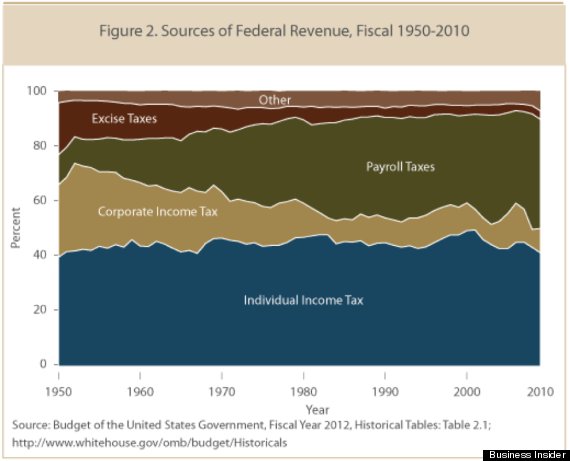
Conservatives like to tout we have the highest corporate tax rate in the world, ignoring entirely the effective tax rate is one of the lowest in the world and we make so much less money off of our corporations compared to many of the other OECD countries/
And we've already established my opinions on the idiocy of corporate taxation and the fallacy that such taxes are paid by the corporation.
Can check their sources yourself. And what has decreasing the effective corporate taxes done to our country? Has it lead us to economic prosperity? Well, it sure hasn't for years now. Even though corporations see record profits, we see diddly.
And how would raising tax rates change that?
The business leader of the plant STILL BROKE THE LAW! That's one thing... But because of this guy's greed and laziness, there are 14 people dead.
And, like I said, it doesn't look like corruption, but rather an excessively loose regulatory environment. Corruption would be the owner paying off local politicians to look the other way or bend regulations; the regulations were mostly federal, they were in place, and they were violated because
they were not enforced.
You have to
assume that people, and corporations, will cut corners wherever possible. It's the job of government to set forth regulations to prevent that behavior from becoming unsafe, to enforce those regulations rigorously, and to prosecute those responsible for breaking those regulations.
Where's the serious court case for the leaders of the plant?
That will depend on what the investigation turns up.
Sure we're finally getting an investigation, but businesses don't get enough of a focus of their atrocities.
And that's a failure of the media, and nobody else.
And, I'd like to bring up this point, this is a prime case of why self regulation won't ever work with a business and why we need government to regulate them.
And when have I ever advocated self-regulation?
And you're right; the instant you post a Young Turks video, I immediately stop watching. Save your effort; find unbiased sources.
And? The banks should be loaning out money, especially when WE'RE GIVING THEM SOME OF THE FUCKING MONEY! If they just sit on the money, it doesn't stimulate the economy. Granted, I can see reason to allow for means to make sure it's not loaned out to high risk people, but that was not the only cause. Another cause was wall street taking toxic mortgages and gambling on them. Amusingly, it probably fucked themselves over.
Banks should be loaning out money to people who it makes sense to loan out money to. Banks should not be
incentivized to make bad loans, which is precisely what happened to cause the most recent financial crisis.
Deregulation (technically poorly thought-out regulation, at that point) simply allowed the disease to spread.
So long as we do have the consumer power, why shouldn't we flex that muscle against the corporations that would pretend to leave our nation because of taxes?
Because technically, at that point they're
someone else's corporation. And if you start imposing punitive taxes on foreign corporations, you start trade wars.
And how many of them really would even leave? Seriously. Where would they go? To other OECD nations with higher effective tax rates?
Depends on what kinds of incentives those governments would offer them in the short term.
Or to non OECD nations which are less stable and less secure?
And where regulatory environments are less rigorous, let's not forget. Consider the percentage of corporate capital tied up in such countries and it's not an enormous stretch to imagine simply relocating the entire corporation there.
This same argument was made in other nations of the world that "oh if we raise taxes on the corporations they'll leave!" and every other corporation (including our own when we have in the past raised taxes on them) did not see them leave the nation. Especially since no one's calling for a tax raise so insane that would drive anyone to want to leave a country outright due to it.
The hypothetical we discussed was what would happen if you did, in fact, tax them heavily enough to make them leave. Not whether it could actually happen.
Btw, about taxes? You know many of our founding fathers were for taxing the rich right?
Btw, about our founding fathers?
What makes you think I give two shits about what a bunch of guys who were willing to say that an African slave is only 3/5th of a person thought?
Oh, I'm sorry, were you possibly confusing me with someone who venerates the "founding fathers"?
Hardly.
I appreciate the core principles of the government they crafted through the Constitution. I understand its shortcomings, of course, but I also take the time to consider the alternatives, and the consequences of what are theoretically "good" actions.
Let's take, for example, a regulation involving health care.
Assume you write a law requiring employers to offer health care to any full-time employees. In theory, you've done a good thing, right?
Except what you've done is offered employers incentives to axe the majority of their full-time employees in favor of part-time employees.
Oops.
I might add that this is almost precisely one of the provisions that will take effect from the PPACA in about 8 months. Employers with more than 50 employees will be required to provide health insurance for any employee who works more than 30 hours per week, or face a $2000 fine per employee.
So, smaller employers right on the cusp of 50 workers might decide to just fire a few of them to drop below the requirements. Larger employers will just decide to slice up their payroll into smaller allotments, firing full-time workers and hiring part-time workers.
And the worst part is that the entire point of the regulation is predicated upon a delusion, specifically the delusion is that the cost of the insurance will be paid by the employer.
It will not.
Now, insurance often costs the employer less, because they get offered deals by insurance companies willing to accept a lower profit margin on the plans in order to secure a large number of policy holders as a result. If you were to, say, forbid that activity to insurance companies, you'd actually create a
more competitive market for insurers.