More Privacy Concerns...

Yeah that what happens when a democrat is in the white house. Just wait till we have another republican, then the media will get back to actually investigating and reporting scandals and "speaking truth to power"


I really hope you were being facetious.
 
You think taxes don't play at all into economic mobility? Look at the facts about how as taxes on the rich have decreased economic mobility has steadily decreased as well.

Correlation does not imply causation. By your standard I can say that electing a black man to the presidency causes persistent unemployment. It's not true, but it is true that this administration has seen very slow recovery in the job market.
It's not necessarily the primary factor, but it is one. If taxes are at a certain level, the rich/corporations are likely to reinvest to pay less in taxes. But when taxes are lower, they take more of their profits and just sit on it.

A cursory analysis of the effects of lowering the capital gains tax strongly undermines your unsupported theory.

As I've said a thousand times already, the rich don't "sit on" their money. It gets invested. Or spent on extravagant baubles, which boosts the economy in its own way. What you're complaining about is individuals and corporations using tax dodges to avoid paying taxes.

Which oddly enough wouldn't be altered by raising tax rates. It would be altered by closing loopholes and the destruction of the anonymous banking system, which I'm all for.

1917-1981: Wage Growth
Top 10%: 31% of the growth
Bottom 90%: 69% of the growth

1981-2012: Wage Growth
Top 10%: 96% of the growth
Bottom 90%: 4% of the growth

Yes that makes perfect sense.

Let's compare a period of staggering economic growth which saw the creation of the modern middle class, the United States surviving untouched through two World Wars that devastated the only other industrial powers of the day, (and leave out the period between 1917 and 1941 which basically had the middle class, such as it was, treading water in the long run), to a period which saw the rise of globalization, in which many manufacturing and service industry workers found themselves competing with people willing to do the same job for a fraction of the cost.

Global Super Rich have moved 21-32 TRILLION DOLLARS to offshore jurisdictions. They have more money stored offshore, not helping anyone in the country that MADE THEM RICH than there is in our entire national debt.

And clearly, raising taxes on the rich will solve the problem of rich people hiding money in anonymous foreign bank accounts that we have no control over. We're just getting Switzerland on board with the idea of ending the concept, and other countries are starting to jump in and fill that gap.

Raising taxes is not the solution.

A strong international treaty dismantling the anonymous banking industry with rigorous enforcement and downright vicious penalties is the solution.


And I already explained to you why productivity and income are not necessarily linked.

Hmm, what policies has our country greatly taken on since the 80s with a stupid ass Celebrity for President? Oh right, trickle down, lower taxes for the wealthy bullshit economics. IT DOES NOT WORK! Enough with these shitty politics that favor only the rich and powerful.

Yeah, because having the government underwrite risky housing loans to people who couldn't afford to buy houses otherwise couldn't possibly have any downsides!

Oh.

Wait.

Yes it did.

It was directly responsible for the worst recession in the country since the Great Depression.

The rise in incomes of the wealthy has nothing to do with reduced taxation. Government income as a share of GDP hasn't varied all that significantly outside of recessions since 1945. Hell, the record is pretty clear that when you cut the capital gains tax, you tend to get higher revenues from it shortly afterward. The share of government revenue that comes from corporate taxation is higher now than it was during that whole period where you laud the income growth of the lower and middle classes.

The problem, in reality, is twofold.

First, a winner-takes-all mentality in corporate culture, emphasizing leadership at the top rather than productivity at the bottom. It's led to the rise of the superstar CEO. Realistically, however, while it makes for awesome graphs about how unfair the country is, the fact is that those superstars pay an equally heroic amount of taxes, and that even if you divvied up their income amongst all the employees of the company, you still wouldn't see massive income growth in the middle class. They're the top one percent, not the top ten percent, or twenty percent. There's only so many ways you can slice that particular pie before you're just distributing crumbs, which is pretty much the way that the boards of directors tend to see it. If I pay this guy $20 million and the company sees 10% growth, would paying him $5 million instead and splitting the other $15 million amongst each of the 50,000 employees see the same result?

Probably not. Since while those 50,000 employees might like seeing an extra $300 in their paycheck, I don't think that a 0.6% raise (to their theoretical average income of $50,000) is going to make them work all that much harder.

And the second is, as I've said a thousand times, globalization. Until the average income across an industry, regardless of what country it's operating in, hits a level within a respectable fraction of what people used to be paid, then wage stagnation will continue.

That and, y'know, it's entirely possible that we've hit an equilibrium in the economic system.

And partially because Unions have been propagandized against too. Guess what Unions brought us when they were strong? Vacations, child labor laws, worker safety laws, etc.

And crippling payroll costs to the industries that they operated within. Seriously, you want to know why the American auto industry basically ended itself and why Detroit is a borderline apocalyptic wasteland these days? Ask the unions.

Welcome to the new world, where a guy in India will do the same job as you for a third the pay and not bitch about.... well, pretty much anything.

Admit it already, tax cuts don't help our country, especially tax cuts on the rich and the corporations.

Why should anyone have to "admit" something that is purely conjecture?

And, more to the point, what does any of this have to do with privacy concerns? Get back on topic people.

I really hope you were being facetious.

Well, I'd rank that statement as 50% ideological blinkering and 50% accurate, to be honest.

I'm not sure if it's a matter of the media being a mirror of the country as a whole, or the country as a whole becoming a mirror of the media, to be honest. I expect that the truth lies somewhere in the middle; a synergistic strengthening of beliefs by virtue of only associating with people who agree with you, and only watching media that reinforces them.

It's like making waves in the bathtub. Pretty soon, you've got enough energy there to splash out onto the bathroom floor.

And seeing as how I'm standing over by the sink, will you jackasses quit splashing around in the tub?

You're getting my shoes all wet with your ideological fail.
 
Last edited:
Ok i was being a little facetious, but only a little.

I mean really, comeon, American media treated Bush like shit, and has had a general love affair with Obama since day 1.

Fast and furious goes largely ignored, as well as sooo many blatant broken promises, they let him get away with taking patriot act/ndaa further then Cheney ever dreamed. I could go on, but whatever, I've learned to live with it. I'll stop splashing

back on topic, you know its not AT&T that wants to eavesdrop on you without a warrant right elem? its the NSA.
 
Last edited:
back on topic, you know its not AT&T that wants to eavesdrop on you without a warrant right elem? its the NSA.

Not to mention that unless you reside/access/transverse a critical infrastructure network, this also shouldn't effect you.
 
Correlation does not imply causation. By your standard I can say that electing a black man to the presidency causes persistent unemployment. It's not true, but it is true that this administration has seen very slow recovery in the job market.

Are you thinking that Economic Mobility isn't affected at all by taxes? I just provided a study showing it does, though it's not necessarily a huge factor, it is still factor. And then look at the statistics of policy change and how has taxes have decreased for the rich, economic mobility has steadily decreased as well. While, yes, correlation is not necessarily causation, to deny there might be some connection is equally stupid.


A cursory analysis of the effects of lowering the capital gains tax strongly undermines your unsupported theory.

As I've said a thousand times already, the rich don't "sit on" their money. It gets invested. Or spent on extravagant baubles, which boosts the economy in its own way. What you're complaining about is individuals and corporations using tax dodges to avoid paying taxes.

Which oddly enough wouldn't be altered by raising tax rates. It would be altered by closing loopholes and the destruction of the anonymous banking system, which I'm all for.

I provided you proof of corporations/the rich sitting on 21-32 Trillion dollars. They aren't investing that money. They put it in offshore accounts and, yes, SIT ON IT! And I do agree that first and foremost closing the bs loopholes and other tax breaks and subsidies is what we should do at first, but I wouldn't turn down the idea of taxing them more. Especially since they get the vast majority of all new income and contain a vast majority of the wealth. Why shouldn't the rich who get the vast majority of the economic benefits be expected to be the lion's share of responsibility? If they actually stopped being greed fuckwads and let the rest of us gain some wealth as well, then I'd be all for perhaps less taxes on them and more taxes on the lower 90%, but that's just not the reality we're in -_- and I still don't get the mindset of protecting the rich who are the only ones in power who continue to rig the system in THEIR benefit. Why? Is there this belief that one day you'll be a part of them? No, no you won't. You will never be one of them.


Yes that makes perfect sense.

Let's compare a period of staggering economic growth which saw the creation of the modern middle class, the United States surviving untouched through two World Wars that devastated the only other industrial powers of the day, (and leave out the period between 1917 and 1941 which basically had the middle class, such as it was, treading water in the long run), to a period which saw the rise of globalization, in which many manufacturing and service industry workers found themselves competing with people willing to do the same job for a fraction of the cost.

And I already explained to you why productivity and income are not necessarily linked.

I gave you the source, go compare any period you want yourself, but the facts still remain that before political contributions from corporations was allowed wage growth distribution was a lot more fair as well as overall wealth distribution and so. But since the late 1970s and especially during Reagan's terrible policy of "trickledown economics" (which EVEN HE went back on as he raised taxes many times during his presidency) we've seen corruption and bribery via campaign contributions increase. Many of who break the laws set in place (even today) and yet nothing is done about it. And we see many of these rich continue to skirt regulations that cost people's lives like the plant in Texas that exploded. And has that owner been arrested? No. Yet some poor girl in I believe Florida doing a science experiment where it exploded (yet no damages were done and no one harmed and she stayed to clean her mess up) was punished for learning and an accident. She's facing FELONY charges, was arrested, and expelled from school. Where the fuck is the equality and the proper justice? -_-

And about regulations, what's one of the big causes of the 2008 recession? LACKING REGULATIONS! Things that both sides of the aisle are to blame for. With Clinton removing Glass-Steagall Act or Bush and the slew of regulations he removed as well as failing to provide needed government oversight of the increasingly dicey mortgage-backed securities market, that caused our Great Recession. Yes, it was also a lot of other factors and partially due to bad decisions by the government (Fed slashing interest rates greatly, congress and the mortgage tax deduction making more people buy more and more houses, etc). A lot of things caused that great recession. But it wasn't necessarily because of the government in the way I've heard basically everyone of the "right" claim. And it wasn't even solely because of the government. And everyone seems to ignore the bankers/wall street and the mortgage companies and real-estate sellers. It's always solely the government.

Just because it's "good business" to take advantage of poor policy doesn't mean the businesses are exempt from blame. Especially when much of the poor policy is at the behest of business owners and businesses. Oh, like, you know, the removal of Glass-Steagall I mentioned earlier? Many who pushed for it were Wall Street lobbyists. Or, at a more local level:

http://motherboard.vice.com/blog/ut...aughterhouse-from-public-street#ixzz2S6mgwde8

This woman who was arrested for filming a slaughterhouse WHILE ON PUBLIC PROPERTY mind you. A law pushed for by the mayor of the city who, surprise surprise, owns that vary slaughter house. A law that, as you should know, is in violation of our constitution and bill of rights.

This marriage of government and business is the biggest problem in our nation. It's what causes all the bad policies that support a few businesses or just one industry and screws the rest. And it needs to be stopped.

As for the other bit about global market and people in other countries working for less, then we punish any and all corporations that outsource. Plain and simple. Why give them any sorta break for not supporting the American people? Cause it saves them some money? But in the long run it means less employed American buyers who are still the primary consumers. And you could argue "well taxing them more will make them leave our nation" and I call bullshit. Most countries (including our own) that have seen increasing taxes on corporations or the rich has not seen them leave the country. And if they were? We merely ban their sales in our nation. Suddenly they'd be bending over to be allowed to sell here because, again, we're still the primary consumers of the world. I could really see a reason to go even further than that, but that gets on another extreme that probably isn't best.


As for back on topic: Yes, the NSA is the one calling for more warrantless bs and our government and I don't disagree that's a problem of the government (or any organization with some kinda power). But that's why we need more people to be made aware, outraged, and protest it.
 
And about regulations, what's one of the big causes of the 2008 recession? LACKING REGULATIONS! Things that both sides of the aisle are to blame for. With Clinton removing Glass-Steagall Act or Bush and the slew of regulations he removed as well as failing to provide needed government oversight of the increasingly dicey mortgage-backed securities market, that caused our Great Recession. Yes, it was also a lot of other factors and partially due to bad decisions by the government (Fed slashing interest rates greatly, congress and the mortgage tax deduction making more people buy more and more houses, etc). A lot of things caused that great recession. But it wasn't necessarily because of the government in the way I've heard basically everyone of the "right" claim. And it wasn't even solely because of the government. And everyone seems to ignore the bankers/wall street and the mortgage companies and real-estate sellers. It's always solely the government.


That because no bank on this earth had some dasterdly evil master plan of giving loans out they knew would never be paid back. LOL "lack of government oversight"? Its our government that threatened, coerced, and encouraged the banks to make those loans, it was DEMOCRAT politicians that were standing outside banks protesting with acorn and threatening to use the full power federal government against a bank if they didn't cave and hand out loans to people both sides knew would never be capable of making the payments on.

Granted, Bush was to blame to, because he played quid pro quo with the democrats, turning a blind eye to their social engineering projects as long as they stayed out of his way with the war on terror.

But to say it was "lack of government oversight" that caused the mortgage crises is laughably false, it was our government that twisted their arms to do it.

not to mention the government itself, (fannie mea/freddie mac) were some of the biggest players in the mortgage-backed securities fiasco after the shit started hitting the fan.

and you've got to be the first person I've ever seen make the case that RAISING taxes creates upward economic mobility, thats absurd,

And also "tickle down" economics(a terrible term) isnt some theory, its a fucking fundamental trait of capitalism. The problem is you don't want a "trickle", you want a waterfall.

and the "sources" you keep linking have almost all been far left political activist trying to make a political point, I dont come here linking graphs from the national review or the weekly standard, so don't come here linking graphs from the brookings institute, or huffington post and expect a "right winger" your arguing with to take it seriously.
 
Last edited:
Are you thinking that Economic Mobility isn't affected at all by taxes? I just provided a study showing it does, though it's not necessarily a huge factor, it is still factor. And then look at the statistics of policy change and how has taxes have decreased for the rich, economic mobility has steadily decreased as well. While, yes, correlation is not necessarily causation, to deny there might be some connection is equally stupid.

Your study doesn't show much of anything regarding the sort, except to state that the rise in income inequality has taken place largely outside of the oft-reviled Bush tax cuts.

"Our results suggest that the net effect of all changes to the federal tax system was relatively small for purposes of the evolution of income inequality."

Blaming the rise in income inequality on reduced taxation of the rich is tenuous at best; I could just as easily claim that the breakdown of traditional family structures in urban African-American culture is causing it, or that the rise in students seeking relatively useless degrees on the grounds that "everyone should go to college" is causing it, or more likely that the nature of corporate culture has changed, and that corporations are simply rewarding the higher ranked officers more richly than they probably deserve.

Rest assured, all of these things are factors, but none of them are easily solved. Your mania for wealth-redistribution will not solve the problems, in large part because it cannot function except in a confiscatory manner, and it's doubtful that such legislation could ever pass muster.

I provided you proof of corporations/the rich sitting on 21-32 Trillion dollars.

You provided evidence. That is not proof, stop thinking that it is.

They aren't investing that money. They put it in offshore accounts and, yes, SIT ON IT!

Offshore accounts are still investments. They're relatively low-return investments, but they're not shoveling gold into a vault somewhere off the coast of Bermuda; they're putting their money in anonymous accounts at investment banks, reaping a lower rate of returns than they would otherwise because that lower rate still nets them greater total income than they might in other low-risk/low-return ventures given the rate of taxation on such income.

This is not complicated or difficult to understand, and I can't fathom why you seem to be having such trouble.

I still don't get the mindset of protecting the rich who are the only ones in power who continue to rig the system in THEIR benefit. Why? Is there this belief that one day you'll be a part of them? No, no you won't. You will never be one of them.

I've no interest in protecting "the rich", I have interest in protecting the system. The whole system, not just the parts that you focus on. Like I said, when the government starts handing out fishes, we need to be extremely worried, but you seem wholeheartedly enthusiastic about the idea, and that disturbs me.

We don't need more money in teaching people to fish, either. We already spend vastly more money per-student than almost any other country, and most of the ones who spend significantly less have notably better results. We need to stop wasting the money that we do spend, however. And a significant portion of that waste comes from the sort of nonsense that liberals everywhere seem to love; sensitivity training, multicultural awareness, tenured teachers and the sorts of nonsense that they get away with, and so on.

As for never being one of them... To be honest, I grew up just shy of being in the so-called "1 percent". We were probably in the top 2 percent though.

My sister's household definitely fell into the top 1 percent until she quit her job last year. Her husband came from relative poverty in fucking Bulgaria and currently makes a fairly ridiculous amount of money.

I'm almost certainly never going to be part of the 1 percent now, in that you are correct. I'm borderline dysfunctional psychologically of course, which tends to be a limiting factor on incomes.

Now, could I have ever become one of the super-rich, leaving my various neuroses out of the picture? Yes. Yes I could have. Because it happens on a fairly regular basis. It's incredibly uncommon, but it's not impossible.

Steve Jobs did not come from money.

I gave you the source, go compare any period you want yourself, but the facts still remain that before political contributions from corporations was allowed wage growth distribution was a lot more fair as well as overall wealth distribution and so.

Which is a vastly more complicated issue than simple taxation.

But since the late 1970s and especially during Reagan's terrible policy of "trickledown economics" (which EVEN HE went back on as he raised taxes many times during his presidency)

Reagan was trying to rationalize the tax code; his tax "raises" were actually the closing of loopholes by which taxes were evaded.

And we see many of these rich continue to skirt regulations that cost people's lives like the plant in Texas that exploded. And has that owner been arrested? No. Yet some poor girl in I believe Florida doing a science experiment where it exploded (yet no damages were done and no one harmed and she stayed to clean her mess up) was punished for learning and an accident. She's facing FELONY charges, was arrested, and expelled from school. Where the fuck is the equality and the proper justice? -_-

The West plant explosion is a tragedy, yet it's unlikely that significant corruption is involved. The plant was small, Texas laws limit the power of local governments to set zoning regulations, and ultimately it looks, more than anything else, like a simple case of what happens when your regulatory environment is too loose. Tragedies happen, and regulations must be intelligently and dispassionately adjusted to compensate.

The girl in Florida, however, is a victim of the same sort of zero-tolerance nonsense that Clinton started back in '94.

And about regulations, what's one of the big causes of the 2008 recession? LACKING REGULATIONS!

Deregulation both is, and is not, a cause.

Odd as that sounds.

What it did was twofold. First, it allowed significantly more banks to get tangled up in the mess, greatly broadening the scope of the problem. Rather than having a small portion of the system fail, almost the whole system was exposed in one form or another.

Secondly, it allowed for banks to package the securities in such a way as to present them as less risky than they actually were. Which, really, was kinda of a bullshit move; just about everyone knew they had to be risky investments, but there was so much money being made that nobody cared so long as things looked good on the quarterly report.

The root cause, however, was the expansion of the housing market at government instigation. Deregulation may well have allowed the problem to come to a head more quickly, but ultimately the government pushed strongly for a housing boom and got exactly what it wished for, complete with the obvious end result of any boom. This isn't an issue of liberal vs conservative, it's an issue of shitty application of Keynesian economic theory that gets way more devotion than it deserves.

Just because it's "good business" to take advantage of poor policy doesn't mean the businesses are exempt from blame.

It wasn't just good business, it was government mandated. As in "you must make at least 28% of your loans to people who shouldn't be getting loans" (Fannie Mae/Freddie Mac). The government push to broaden the housing market, particularly to people with lower incomes, would ultimately relax regulations (on purpose, and to support policies one would typically define as "liberal") to such a point as to create a veritable feeding frenzy in the market.

As for the other bit about global market and people in other countries working for less, then we punish any and all corporations that outsource. Plain and simple. Why give them any sorta break for not supporting the American people? Cause it saves them some money? But in the long run it means less employed American buyers who are still the primary consumers. And you could argue "well taxing them more will make them leave our nation" and I call bullshit. Most countries (including our own) that have seen increasing taxes on corporations or the rich has not seen them leave the country. And if they were? We merely ban their sales in our nation. Suddenly they'd be bending over to be allowed to sell here because, again, we're still the primary consumers of the world. I could really see a reason to go even further than that, but that gets on another extreme that probably isn't best.

You...

Dear god.

Do you actually think that such a policy would be wise?

Do you have any idea of the economic ramifications of that sort of action?

First off, it would be impossible to raise taxes on domestic corporations without according raising duties on foreign corporations, lest economic competitiveness diminish to the point where the US economy goes into total stagnation.

As an immediate result, you'd have other countries raising their duties on American corporations.

Congratulations, you've sparked a trade war. Nobody wins a trade war.

On the flip side, let's say that somehow, magically, you can increase taxes significantly without raising import duties. It's a fantasy equivalent to anything cooked up by Square-Enix, but hey, we're imagining here. Let's run with it.

You're right, the United States remains the worlds largest single consumer (though, to be fair, the EU is a bigger market taken as a whole, and China/India are catching up quickly). If you genuinely started seeing a mass exodus of corporations from the United States... what the fuck makes you think we'd have enough economic leverage to dictate terms? Remember, your policy of punitive taxation has led corporations to leave; that means people have no jobs with which to buy their products anyway.

Taxes are a delicate thing. You don't raise them arbitrarily; you can lower them arbitrarily, so long as you control costs, but raising them is tricky business at best. Think of it like balancing classes in an MMO; nobody complains when you give something out, but everybody bitches when you take something away.


As for back on topic: Yes, the NSA is the one calling for more warrantless bs and our government and I don't disagree that's a problem of the government (or any organization with some kinda power). But that's why we need more people to be made aware, outraged, and protest it.

Protesting is great.

Do it intelligently.

What you don't do is immediately start calling anyone who doesn't agree with you an idiot. You can wind up there, but you never open a debate that way.

The only purpose that serves is more of that ideological splashing I mentioned earlier. You wind up with two sides yelling and screaming at their opponents solely to prove to the people who already agree with them how wrong their opponents are.

You won't win converts that way.

That sort of idiotic mentality is one of the root causes for the dysfunction of our political climate, incidentally, in the form of the primary system. You wind up with candidates in the same party competing against each other to capture as much of their own electorate as possible, which sounds good in theory until you realize that the only way to do that is to shift further towards the extremes of the people who support you.

Candidates make promises they can't keep, state positions they don't believe, and generally get into the habit of lying their asses off because it's the only way to get the nod for the general election, often as not.
 
Your study doesn't show much of anything regarding the sort, except to state that the rise in income inequality has taken place largely outside of the oft-reviled Bush tax cuts.

"Our results suggest that the net effect of all changes to the federal tax system was relatively small for purposes of the evolution of income inequality."

Blaming the rise in income inequality on reduced taxation of the rich is tenuous at best; I could just as easily claim that the breakdown of traditional family structures in urban African-American culture is causing it, or that the rise in students seeking relatively useless degrees on the grounds that "everyone should go to college" is causing it, or more likely that the nature of corporate culture has changed, and that corporations are simply rewarding the higher ranked officers more richly than they probably deserve.

Rest assured, all of these things are factors, but none of them are easily solved. Your mania for wealth-redistribution will not solve the problems, in large part because it cannot function except in a confiscatory manner, and it's doubtful that such legislation could ever pass muster.

Yes, small, but it is a factor. I never said it was the only one, but it is still one that should be addressed.

You provided evidence. That is not proof, stop thinking that it is.

I provided evidence to prove it, yes, that doesn't necessarily mean it is proven, but you've provided nothing to disprove it have you? While that's not enough alone, given the evidence so far, it is, for all intense and purposes to the conversation, true. If you have facts to back up that they don't send so much money offshore, than please do show it.

Offshore accounts are still investments. They're relatively low-return investments, but they're not shoveling gold into a vault somewhere off the coast of Bermuda; they're putting their money in anonymous accounts at investment banks, reaping a lower rate of returns than they would otherwise because that lower rate still nets them greater total income than they might in other low-risk/low-return ventures given the rate of taxation on such income.

This is not complicated or difficult to understand, and I can't fathom why you seem to be having such trouble.

See that's not necessarily true either. There was a story at the Financial Times about bonds being given at 0% interest that will guarantee your money back in 2 years from German groups and a lot of the rich were taking that up. Why? Well some were suspecting it's because they're worried about a crash so bad that they're worried about just getting money back, not necessarily making profits.

But in general, sure they have a tiny return, but the reason they do it is to avoid paying more taxes on their profit because they are greedy. Why should we even allow this to happen in the first place with our laws anyways? Why shouldn't their be taxes on those who try to move their money out of our country? The very country that made them rich in the first place.

I've no interest in protecting "the rich", I have interest in protecting the system. The whole system, not just the parts that you focus on. Like I said, when the government starts handing out fishes, we need to be extremely worried, but you seem wholeheartedly enthusiastic about the idea, and that disturbs me.

We don't need more money in teaching people to fish, either. We already spend vastly more money per-student than almost any other country, and most of the ones who spend significantly less have notably better results. We need to stop wasting the money that we do spend, however. And a significant portion of that waste comes from the sort of nonsense that liberals everywhere seem to love; sensitivity training, multicultural awareness, tenured teachers and the sorts of nonsense that they get away with, and so on.

As for never being one of them... To be honest, I grew up just shy of being in the so-called "1 percent". We were probably in the top 2 percent though.

My sister's household definitely fell into the top 1 percent until she quit her job last year. Her husband came from relative poverty in fucking Bulgaria and currently makes a fairly ridiculous amount of money.

I'm almost certainly never going to be part of the 1 percent now, in that you are correct. I'm borderline dysfunctional psychologically of course, which tends to be a limiting factor on incomes.

Now, could I have ever become one of the super-rich, leaving my various neuroses out of the picture? Yes. Yes I could have. Because it happens on a fairly regular basis. It's incredibly uncommon, but it's not impossible.

Steve Jobs did not come from money.

See, and that's the problem, because the system as a whole is broken. The system as a whole is built around favoring the rich and powerful. Hell, considering they're the only ones who can even afford to run (or you have to be a huge sellout to PACs and Super PACs and various groups as well as having some popularity) for our federal government, why wouldn't they have rigged the system in their favor?

And what's wrong with tenure? It requires a just cause to fire teachers. That should be the case in a public school. But at the same time I'd say our standards for teachers should be stricter as well. Take Finland for example, they greatly outperform the US in all areas. Finland does not allow private/charter schools to exists, only socialized/public schools exist in Finland. However, all teachers in Finland must have a masters degree and that there are more teachers per student than in the US. Furthermore, to receive a masters degree the costs for receiving it aren't so out of line as they are in our country... that all factors greatly into helping education (a subject you've touched on before) and if we have teachers of such a caliber, then they should get a sort of tenure where there has to be a just cause for their firing.

I will also note that teachers in Finland are paid better too, and yes, I am saying pay can help, but that doesn't mean pay alone determines how good a person is nor that a higher pay will always bring in the best person for the job. That for some instances, like with our government or CEOs, we don't see pay helping bring in the best for the job to make the organization successful for the long term, just to get what they want out of it in the short term.

As for any sensitivity training or multicultural stuff? I don't know of the costs of those on our society, I doubt it's not near the costs of other things like various tax loop holes the rich take advantage of, but I'd agree those are frivolous things and should be removed. Society itself can teach people how to be sensitive to others and to be more understanding of many cultures. Hell, if our education system was more complete that alone should help people think critically more to alone for being understanding and patient with others and should open people's minds up to other cultures there. They wouldn't be a class dedicated on those things, I'm saying, just that those should come naturally from a better education system.

But no, don't defend the system, the system is broken. And it's broken in the favor of a very few who are in power. That's why there's a push for an amendment to our constitution to remove corporate and union money from politics. That's why there are some states discussing the call of a constitutional convention on such so they can bypass Washington all together.

Which is a vastly more complicated issue than simple taxation.

I agree, it's not just taxation, there's more to it, but taxation is one part of it. Even if a smaller part than compared to other issues, it's still a part and shouldn't be ignored.

Reagan was trying to rationalize the tax code; his tax "raises" were actually the closing of loopholes by which taxes were evaded.

Closing loop holes still raises the effective tax rate. The effective tax rate is all that matters. Not the number claimed to be the tax rate, but the ACTUAL taxes paid to the government is what matters. Conservatives like to tout we have the highest corporate tax rate in the world, ignoring entirely the effective tax rate is one of the lowest in the world and we make so much less money off of our corporations compared to many of the other OECD countries

Here's a nice PDF: http://www.ctj.org/pdf/oecd201106.pdf

Can check their sources yourself. And what has decreasing the effective corporate taxes done to our country? Has it lead us to economic prosperity? Well, it sure hasn't for years now. Even though corporations see record profits, we see diddly.

And this might be a blog: http://opinionator.blogs.nytimes.com/2013/04/14/a-tax-system-stacked-against-the-99-percent/

But it's still well written with evidence backing it up.

Also this: http://www.nationofchange.org/five-tax-fallacies-invented-1-1335792996

The West plant explosion is a tragedy, yet it's unlikely that significant corruption is involved. The plant was small, Texas laws limit the power of local governments to set zoning regulations, and ultimately it looks, more than anything else, like a simple case of what happens when your regulatory environment is too loose. Tragedies happen, and regulations must be intelligently and dispassionately adjusted to compensate.

The girl in Florida, however, is a victim of the same sort of zero-tolerance nonsense that Clinton started back in '94.

http://www.reuters.com/article/2013/04/20/us-usa-explosion-regulation-idUSBRE93J09N20130420

The business leader of the plant STILL BROKE THE LAW! That's one thing

http://www.washingtonpost.com/opini...770c-ac26-11e2-b6fd-ba6f5f26d70e_story_1.html

See this? Check their links? No sprinklers, no shut off valve, fire alarms, blast walls, etc. This bit on the Washington post is talking more about how the media fails at talking about this blast and focusing more on terrorism, but the points are still there. The guy didn't meet the standards required. Where are the calls for his head? The terrorists in Boston killed only 3 people, people want to do horrible things to those guys. But because of this guy's greed and laziness, there are 14 people dead.

Where's the serious court case for the leaders of the plant? Sure we're finally getting an investigation, but businesses don't get enough of a focus of their atrocities. And, I'd like to bring up this point, this is a prime case of why self regulation won't ever work with a business and why we need government to regulate them. Why defunding OSHA and so.

You might find this guy biased, I don't care, he makes good points:

https://www.youtube.com/watch?v=aUvv9i6QKy0

Deregulation both is, and is not, a cause.

Odd as that sounds.

What it did was twofold. First, it allowed significantly more banks to get tangled up in the mess, greatly broadening the scope of the problem. Rather than having a small portion of the system fail, almost the whole system was exposed in one form or another.

Secondly, it allowed for banks to package the securities in such a way as to present them as less risky than they actually were. Which, really, was kinda of a bullshit move; just about everyone knew they had to be risky investments, but there was so much money being made that nobody cared so long as things looked good on the quarterly report.

The root cause, however, was the expansion of the housing market at government instigation. Deregulation may well have allowed the problem to come to a head more quickly, but ultimately the government pushed strongly for a housing boom and got exactly what it wished for, complete with the obvious end result of any boom. This isn't an issue of liberal vs conservative, it's an issue of shitty application of Keynesian economic theory that gets way more devotion than it deserves.

It wasn't just good business, it was government mandated. As in "you must make at least 28% of your loans to people who shouldn't be getting loans" (Fannie Mae/Freddie Mac). The government push to broaden the housing market, particularly to people with lower incomes, would ultimately relax regulations (on purpose, and to support policies one would typically define as "liberal") to such a point as to create a veritable feeding frenzy in the market.

And? The banks should be loaning out money, especially when WE'RE GIVING THEM SOME OF THE FUCKING MONEY! If they just sit on the money, it doesn't stimulate the economy. Granted, I can see reason to allow for means to make sure it's not loaned out to high risk people, but that was not the only cause. Another cause was wall street taking toxic mortgages and gambling on them. Amusingly, it probably fucked themselves over

http://www.princeton.edu/~wxiong/papers/WallStreet.pdf

You...

Dear god.

Do you actually think that such a policy would be wise?

Do you have any idea of the economic ramifications of that sort of action?

First off, it would be impossible to raise taxes on domestic corporations without according raising duties on foreign corporations, lest economic competitiveness diminish to the point where the US economy goes into total stagnation.

As an immediate result, you'd have other countries raising their duties on American corporations.

Congratulations, you've sparked a trade war. Nobody wins a trade war.

On the flip side, let's say that somehow, magically, you can increase taxes significantly without raising import duties. It's a fantasy equivalent to anything cooked up by Square-Enix, but hey, we're imagining here. Let's run with it.

You're right, the United States remains the worlds largest single consumer (though, to be fair, the EU is a bigger market taken as a whole, and China/India are catching up quickly). If you genuinely started seeing a mass exodus of corporations from the United States... what the fuck makes you think we'd have enough economic leverage to dictate terms? Remember, your policy of punitive taxation has led corporations to leave; that means people have no jobs with which to buy their products anyway.

Taxes are a delicate thing. You don't raise them arbitrarily; you can lower them arbitrarily, so long as you control costs, but raising them is tricky business at best. Think of it like balancing classes in an MMO; nobody complains when you give something out, but everybody bitches when you take something away.

So long as we do have the consumer power, why shouldn't we flex that muscle against the corporations that would pretend to leave our nation because of taxes? And how many of them really would even leave? Seriously. Where would they go? To other OECD nations with higher effective tax rates? Or to non OECD nations which are less stable and less secure? They wouldn't leave at all. This same argument was made in other nations of the world that "oh if we raise taxes on the corporations they'll leave!" and every other corporation (including our own when we have in the past raised taxes on them) did not see them leave the nation. Especially since no one's calling for a tax raise so insane that would drive anyone to want to leave a country outright due to it.

Btw, about taxes? You know many of our founding fathers were for taxing the rich right?

In 1811, two years after Jefferson left the Presidency, Jefferson wrote a letter to General Thaddeus Kosciuszko, a hero of the American Revolution. Jefferson said that he supported taxes (then tariffs, since there was no income tax yet) falling entirely on the wealthy. As Jefferson explained: "The farmer will see his government supported, his children educated, and the face of this country made a paradise by the contributions of the rich alone, without his being called on to spend a cent from his earnings."

Here is someone else who was an outspoken proponent of progressive taxation: Adam Smith, who literally "wrote the book" on capitalism. In 1776, in The Wealth of Nations, Smith wrote:

"The necessaries of life occasion the great expense of the poor. They find it difficult to get food, and the greater part of their little revenue is spent in getting it. The luxuries and vanities of life occasion the principal expense of the rich, and a magnificent house embellishes and sets off to the best advantage all the other luxuries and vanities which they possess. A tax upon house-rents, therefore, would in general fall heaviest upon the rich; and in this sort of inequality there would not, perhaps, be anything unreasonable. It is not very unreasonable that the rich should contribute to the public expense, not only in proportion to their revenue, but something more than in that proportion."

And this was in the other thread, but gonna bring it here:

Well duh.

That's what corporations do: seek ways to make money.

The job of government is to work against that. Yet, ironically, you spend most of your time railing against corporations rather than elected officials.

And I do, I rally against the government as well, but I don't ignore the masters they adhere to. It's like a mafia organization. The person who does the actual harm are the underlings that go and put fear into people to extort money right? Yet why would you only go after the underlings who listen to the master who might not have done any actual harm to others personally themselves, but organized it so it does happen? No, you go after the head of the problem. And the head of the problem can be traced by following the money, the corporations and, yes, even the Unions.

That's why the most important issue should be getting such money out of politics. They are NOT people. They are machines. They are tools. Corporations are tools/entities/machines (whatever you want to call them) that make money and Unions are tools/machines/whatever that are supposed to be about protecting worker's rights (though it's become about money in some cases in history as well). There's NO reason they get to be protected under the constitution. The people that make up the unions or corporation? Yes, they are protected. The organization itself? Nope.

Why let them continue to even have the ability to corrupt and influence our government anyways?
 
Last edited:
Yes, small, but it is a factor. I never said it was the only one, but it is still one that should be addressed.

The only effect taxation has on wealth inequality is that it allows the rich to keep more of their wealth. It does not allow the poor to accumulate more. Or the middle class, for the most part.

I'd be significantly more worried about a system of predatory lending that conspires to keep the poor poor indefinitely than whether the highest marginal tax rates aren't high enough.

I provided evidence to prove it, yes, that doesn't necessarily mean it is proven, but you've provided nothing to disprove it have you? While that's not enough alone, given the evidence so far, it is, for all intense and purposes to the conversation, true. If you have facts to back up that they don't send so much money offshore, than please do show it.

I don't have to; the article you posted did that for me. It shows up in the part where it's a group intending to prove tax inequality, and that the ultimate numbers arrived by "our analysis".

The problem with their analysis is fairly straightforward. They took an sample of developing countries, estimated the amount of wealth flowing out of them due largely to corruption and tax evasion, and then extrapolated that to the rest of the world based on a number they have apparently pulled entirely out of their ass. They're being relatively open with their methodology, and for that I applaud them, but the final number is... questionable at best.

Besides, we've already established I'm all for closing down tax havens and the anonymous banking system.

See that's not necessarily true either. There was a story at the Financial Times about bonds being given at 0% interest that will guarantee your money back in 2 years from German groups and a lot of the rich were taking that up. Why? Well some were suspecting it's because they're worried about a crash so bad that they're worried about just getting money back, not necessarily making profits.

This is called "hedging your bets", and functionally everyone does it, not just the rich. It's the same kind of mentality that leads people to buy silver or gold and stuff it in a safety deposit box somewhere.

But in general, sure they have a tiny return, but the reason they do it is to avoid paying more taxes on their profit because they are greedy.

And the reason you take steps to avoid paying any more taxes than you have to is because you are greedy.


See, and that's the problem, because the system as a whole is broken.

Define broken.

Greece, for example, is broken. Greece is broken because the government wound up handing out benefits and sinecures that it could not afford, borrowing against future incomes that did not materialize.

The path you appear to be advocating, of forcible wealth redistribution in order to "raise up" the lower classes, points down a similar path to failure. The street signs are slightly different, but the destination is the same.

The way to raise up the lower classes is not to throw money at them. In fact, in many ways, we're already throwing too much money at them. Government intervention into markets is ham-handed at the best of times; what we need are better regulations, not more interventions.

And what's wrong with tenure?

Are you kidding?

Tenure is a fucking nightmare. Tenure is why New York City spends tens of millions of dollars a year to warehouse teachers they can't just fire, because the tenure rules require arbitration, and the union has conspired to make that arbitration incredibly difficult. A handful of arbitrators that work barely a week out of the month leaves teachers stuck waiting years for their case to be resolved, all the while collecting their full salaries.

The whole concept of tenure leads to massive uncertainty in the existence of new teachers; many school districts have taken up the mentality that it's cheaper to just "fire" teachers before they achieve tenure, and then rehire them for the next school year.

It requires a just cause to fire teachers.

It requires just cause to fire most people, to be honest. Certainly any union employee. But tenure goes a step beyond that.

Take Finland for example, they greatly outperform the US in all areas.

And yet we spend almost 50% more per student than Finland.

Finland has a higher rate of family involvement in education than the United States does. The ongoing education requirements of the vast majority of US public school teachers means that most of them have significantly more education in the field than might be suggested by their degrees, though over half do ultimately formalize it with a master's degree.

As for any sensitivity training or multicultural stuff?

Billions of dollars a year in a general sense, but I was talking about education specifically.

As a nation, we spent ~25 billion dollars on things like teacher salaries, curriculum development, staff training, libraries, and media and computer centers in the 08-09 school year.

We spent ~40 billion dollars on administrative positions. In Maine, for example, between 1992 and 2009, the number of actual teaching positions increased by 3%. The number of non-teaching and administrative positions during the same period? Increased by 76%.

What's fueling this incredible growth in administrative costs? Sensitivity training, multicultural awareness training, positions to manage such training, and so on.

And the worst part is that for the most part, there's functionally zero evidence saying that such training has any significant effects.


But no, don't defend the system, the system is broken.

It is. But you are advocating breaking it in a different way.

Broken is still broken.


Conservatives like to tout we have the highest corporate tax rate in the world, ignoring entirely the effective tax rate is one of the lowest in the world and we make so much less money off of our corporations compared to many of the other OECD countries/

And we've already established my opinions on the idiocy of corporate taxation and the fallacy that such taxes are paid by the corporation.

Can check their sources yourself. And what has decreasing the effective corporate taxes done to our country? Has it lead us to economic prosperity? Well, it sure hasn't for years now. Even though corporations see record profits, we see diddly.

And how would raising tax rates change that?

The business leader of the plant STILL BROKE THE LAW! That's one thing... But because of this guy's greed and laziness, there are 14 people dead.

And, like I said, it doesn't look like corruption, but rather an excessively loose regulatory environment. Corruption would be the owner paying off local politicians to look the other way or bend regulations; the regulations were mostly federal, they were in place, and they were violated because they were not enforced.

You have to assume that people, and corporations, will cut corners wherever possible. It's the job of government to set forth regulations to prevent that behavior from becoming unsafe, to enforce those regulations rigorously, and to prosecute those responsible for breaking those regulations.

Where's the serious court case for the leaders of the plant?

That will depend on what the investigation turns up.

Sure we're finally getting an investigation, but businesses don't get enough of a focus of their atrocities.

And that's a failure of the media, and nobody else.

And, I'd like to bring up this point, this is a prime case of why self regulation won't ever work with a business and why we need government to regulate them.

And when have I ever advocated self-regulation?

And you're right; the instant you post a Young Turks video, I immediately stop watching. Save your effort; find unbiased sources.


And? The banks should be loaning out money, especially when WE'RE GIVING THEM SOME OF THE FUCKING MONEY! If they just sit on the money, it doesn't stimulate the economy. Granted, I can see reason to allow for means to make sure it's not loaned out to high risk people, but that was not the only cause. Another cause was wall street taking toxic mortgages and gambling on them. Amusingly, it probably fucked themselves over.

Banks should be loaning out money to people who it makes sense to loan out money to. Banks should not be incentivized to make bad loans, which is precisely what happened to cause the most recent financial crisis.

Deregulation (technically poorly thought-out regulation, at that point) simply allowed the disease to spread.

So long as we do have the consumer power, why shouldn't we flex that muscle against the corporations that would pretend to leave our nation because of taxes?

Because technically, at that point they're someone else's corporation. And if you start imposing punitive taxes on foreign corporations, you start trade wars.

And how many of them really would even leave? Seriously. Where would they go? To other OECD nations with higher effective tax rates?

Depends on what kinds of incentives those governments would offer them in the short term.

Or to non OECD nations which are less stable and less secure?

And where regulatory environments are less rigorous, let's not forget. Consider the percentage of corporate capital tied up in such countries and it's not an enormous stretch to imagine simply relocating the entire corporation there.

This same argument was made in other nations of the world that "oh if we raise taxes on the corporations they'll leave!" and every other corporation (including our own when we have in the past raised taxes on them) did not see them leave the nation. Especially since no one's calling for a tax raise so insane that would drive anyone to want to leave a country outright due to it.

The hypothetical we discussed was what would happen if you did, in fact, tax them heavily enough to make them leave. Not whether it could actually happen.

Btw, about taxes? You know many of our founding fathers were for taxing the rich right?

Btw, about our founding fathers?

What makes you think I give two shits about what a bunch of guys who were willing to say that an African slave is only 3/5th of a person thought?

Oh, I'm sorry, were you possibly confusing me with someone who venerates the "founding fathers"?

Hardly.

I appreciate the core principles of the government they crafted through the Constitution. I understand its shortcomings, of course, but I also take the time to consider the alternatives, and the consequences of what are theoretically "good" actions.

Let's take, for example, a regulation involving health care.

Assume you write a law requiring employers to offer health care to any full-time employees. In theory, you've done a good thing, right?

Except what you've done is offered employers incentives to axe the majority of their full-time employees in favor of part-time employees.

Oops.

I might add that this is almost precisely one of the provisions that will take effect from the PPACA in about 8 months. Employers with more than 50 employees will be required to provide health insurance for any employee who works more than 30 hours per week, or face a $2000 fine per employee.

So, smaller employers right on the cusp of 50 workers might decide to just fire a few of them to drop below the requirements. Larger employers will just decide to slice up their payroll into smaller allotments, firing full-time workers and hiring part-time workers.

And the worst part is that the entire point of the regulation is predicated upon a delusion, specifically the delusion is that the cost of the insurance will be paid by the employer.

It will not.

Now, insurance often costs the employer less, because they get offered deals by insurance companies willing to accept a lower profit margin on the plans in order to secure a large number of policy holders as a result. If you were to, say, forbid that activity to insurance companies, you'd actually create a more competitive market for insurers.

 
Last edited:
The only effect taxation has on wealth inequality is that it allows the rich to keep more of their wealth. It does not allow the poor to accumulate more. Or the middle class, for the most part.

I'd be significantly more worried about a system of predatory lending that conspires to keep the poor poor indefinitely than whether the highest marginal tax rates aren't high enough.

http://papers.nber.org/tmp/79822-w19075.pdf

I dunno, sure seems over time as taxes are cut for the rich, income inequality increases and economic mobility decreases.

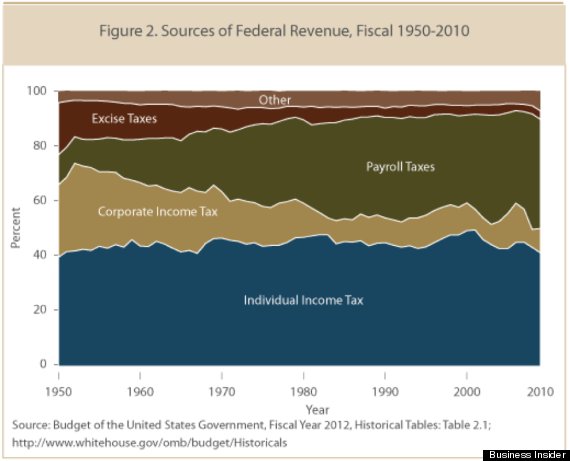
And then there's this nice graph

o-FEDERAL-REVENUE-570.jpg


You think that doesn't play a big role in wealth disparity? Since most of those higher up the corporate scale who get most of the benefits of corporations paying less taxes we see them getting bigger and bigger bonuses and salaries. And look at that graph? Look at who is starting to take more and more of the tax burden? Those who are affected by payroll tax. Who do you think is most affected by payroll tax? Yes the employee pays a part, but so does the employee. The less corporate taxes, the more payroll tax increases, the less on the employee/corporation over all and the more on the worker ( http://www.cbpp.org/cms/index.cfm?fa=view&id=3505 ). And that's how the wealth can get pushed upwards by taxes.


This is called "hedging your bets", and functionally everyone does it, not just the rich. It's the same kind of mentality that leads people to buy silver or gold and stuff it in a safety deposit box somewhere.

irrelevant, my point was that there are many off short banks/bonds that they put their money into that doesn't create them more money, just keeps the money outta circulation over here or being invested in new businesses and in their hands and, for now, the hands of the banks in other nations that hold it (and they might invest it, true, they might not, they certainly don't invest it all).

And the reason you take steps to avoid paying any more taxes than you have to is because you are greedy.

I don't take any steps to avoid paying my taxes >.> not a single damn one. I could probably put in the amount I've donated to charity or the hours of charity work or various other things that would be tax deductible, but that just isn't something I care enough about. And then I feel like charity I do is more for me instead about for the other person. That is just ethically/morally wrong to me. I don't mind paying my full taxes for my income or if I owned property or so, it's reasonable. But I don't like a group of people who have the majority of our wealth screwing over the nation for their greed. And they do it constantly.


Define broken.

Greece, for example, is broken. Greece is broken because the government wound up handing out benefits and sinecures that it could not afford, borrowing against future incomes that did not materialize.

The path you appear to be advocating, of forcible wealth redistribution in order to "raise up" the lower classes, points down a similar path to failure. The street signs are slightly different, but the destination is the same.

The way to raise up the lower classes is not to throw money at them. In fact, in many ways, we're already throwing too much money at them. Government intervention into markets is ham-handed at the best of times; what we need are better regulations, not more interventions.

Answer this, do you REALLY think our system is "of the people, by the people, for the people" anymore? When you see the only ones who are even able to run for government are the upper class, when the only ones who are writing the bills are the lobbyists who work for the wealth corporations? It's disgusting. Our system was never intended to serve the elite few and the rich. Never once. Was never thought to support corporations the way it does (hell, corporations back in the day weren't even a permanent thing, they were temporary). Yet even Google's CEO has come out about how much lobbying influences Washington: http://www.theatlantic.com/technolo...-ceo-the-laws-are-written-by-lobbyists/63908/ and here's an example of lobbyists writing a bill pushed in congress http://dealbook.nytimes.com/2013/05/23/banks-lobbyists-help-in-drafting-financial-bills/ the bank lobbyists basically writing the entire bill and just having their corporate shills in congress push it.

Since when do we elect Lobbyists to write our laws? Since when do corporations EVER get a right or are protected by the constitution? They are by no means of the definition of "person" a person. They are not people. They are machines, they are tools that humans created to do specific tasks. And they've been tasked with the making of profit.

Or how about our supposed justice system? With Eric Holder (and not just him, so let's not ignore Michael Mukasey and Alberto Gonzales and John Ashcroft and so many others) refusal to prosecute the banks or other corporations cause "too big to jail" because they fear the repercussions on the economy.

Or how about the bank regulators that are all from wall street or banks and they refuse to regulate them. Elizabeth Warren shamed this one them very nicely


Or how about citizens united and the damage it has done where corporations take over more of our political process and the election cycle


And here's a nice image I like for the broken aspect of our nation, a man who steals a $100 bucks and gives it back, 15 years in prison, a CEO with one of the biggest frauds in the nation? Stealing 3 billion? 40 months. What a fucking joke.

injustice-for-all.png


Or here's another example:

http://www.rollingstone.com/politic...r-demanding-wall-street-prosecutions-20130522

People adhering to their 1st amendment rights, they get arrested. The bankers that do fraud or false foreclosures on homes or so? Nope...

And you think our system ISN'T broken? That it isn't favoring only the corporations and the rich? You're naive, very much so, if you think it isn't. It is broken, and it's not in the best interest as the people for a whole.


Are you kidding?

Tenure is a fucking nightmare. Tenure is why New York City spends tens of millions of dollars a year to warehouse teachers they can't just fire, because the tenure rules require arbitration, and the union has conspired to make that arbitration incredibly difficult. A handful of arbitrators that work barely a week out of the month leaves teachers stuck waiting years for their case to be resolved, all the while collecting their full salaries.

The whole concept of tenure leads to massive uncertainty in the existence of new teachers; many school districts have taken up the mentality that it's cheaper to just "fire" teachers before they achieve tenure, and then rehire them for the next school year.

It requires just cause to fire most people, to be honest. Certainly any union employee. But tenure goes a step beyond that.


And? System isn't perfect, ya, but tenure on its own (as a concept) isn't a bad thing. It's rewarding those who have proven to be valuable. And there might be a problem such with the way we handle it now, we should fix that, agreed. There should be a better means to remove a teacher who isn't doing their job. But the pure idea of tenure is that they can't be "just fired" for no reason and proof must be given. Why is that a bad thing as a concept?

All definitions of tenure I can find, especially academic, is exactly that. can't be fired without a just cause. And no, there are many areas people can be fired without a reason at all. Whether it's fair or not, depends. But not everyone need give a just cause. Usually the only time is with tenure or if there are unions backing the workers up that requires the corporation/business to provide a valid cause. And I don't think that's so unfair to be honest.


Edit:

And yet we spend almost 50% more per student than Finland.

Finland has a higher rate of family involvement in education than the United States does. The ongoing education requirements of the vast majority of US public school teachers means that most of them have significantly more education in the field than might be suggested by their degrees, though over half do ultimately formalize it with a master's degree.

Billions of dollars a year in a general sense, but I was talking about education specifically.

As a nation, we spent ~25 billion dollars on things like teacher salaries, curriculum development, staff training, libraries, and media and computer centers in the 08-09 school year.

We spent ~40 billion dollars on administrative positions. In Maine, for example, between 1992 and 2009, the number of actual teaching positions increased by 3%. The number of non-teaching and administrative positions during the same period? Increased by 76%.

What's fueling this incredible growth in administrative costs? Sensitivity training, multicultural awareness training, positions to manage such training, and so on.

And the worst part is that for the most part, there's functionally zero evidence saying that such training has any significant effects.

I don't disagree that spending isn't necessarily the problem with our nation's education, but it could also be a problem considering we have schools being closed in the country right now because of budget cuts. And we see more and more of the idiot politicians (mostly Republicans) advocating for MORE CUTS to education to "balance the budget" yet ignore the bloated military budget that makes up 59% of our discretionary spending and closing real loopholes and tax havens and ending the ridiculous tax break for the upper class and corporations.

And I wonder at the administrative data. Where's the real cost figures for those supposed sensitivty training, multicultural awareness, and other such things? How much does that really cost us? And if it really has no benefit, sure, get rid of it. But why did administrative positions grow 76%? Why did it need to? Or did it not? Why are there salaries for administrators I recall seeing for NY alone (not the city only, but the entire state, so even places with a lower cost of living) where they get upwards of $500k a year? I dunno, I feel like there's not enough information about what the problem could be in regards to costs in the system, and it might not even be a cost problem and could be other issues like the idiot religious groups that demand we not teach various sciences cause "IT GOES AGAINST OUR BELIEFS" not realizing that public schools are not beholden to your beliefs and it'd be unconstitutional for them to teach their beliefs. Or religious groups having a sway of power in the textbooks public schools get (at the very least in Texas) and other stupidity. Like the "science commmittee" members of congress and how so many of them are swearing science is "lies straight from the pit of hell" and these kinda idiots have ANY say on science or education? To hell with them.

It is. But you are advocating breaking it in a different way.

Broken is still broken.

No, I'm not. I'm advocating removing the broken nature where corporations can buy our politicians off. Where they write the bills through their lobbyists.


And we've already established my opinions on the idiocy of corporate taxation and the fallacy that such taxes are paid by the corporation.

And how would raising tax rates change that?

And your opinion is just that, an opinion. The reality shows lowering corporate taxes has done nothing to help us. I don't get why you think a corporation would be altruistic and lower their prices when people have come accustomed to the costs if they really paid 0% in taxes. And you might argue free market, but what insentive do the others have to lowering their costs? Especially as more and more corporations are trying to drive towards a monopoly and merging to become too big to regulate.

And, like I said, it doesn't look like corruption, but rather an excessively loose regulatory environment. Corruption would be the owner paying off local politicians to look the other way or bend regulations; the regulations were mostly federal, they were in place, and they were violated because they were not enforced.

You have to assume that people, and corporations, will cut corners wherever possible. It's the job of government to set forth regulations to prevent that behavior from becoming unsafe, to enforce those regulations rigorously, and to prosecute those responsible for breaking those regulations.

*Bangs head on desk* There is corruption when the very people who deregulate areas or create various weak laws or appoint/control the regulators are in the pockets of the corporations or businesses. I'll give you a fine example:

http://www.vice.com/read/a-utah-wom...filming-a-slaughterhouse-from-a-public-street

Utah woman was arrested for filminmg a slaughterhouse from a public street. There was a law pushed making that illegal (let's recall how unconstitutional this is now) and who pushed that law? The mayor of the town, and wait, what's that? Why, the very mayor who pushed that law ALSO owns the slaughterhouse that she was filming! My oh my, that seems pretty corrupt. A businessman who comes into politics to push things that only helps them at the cost of our constitutional rights. Sounds familiar to me. Oh wait, that happens constantly in congress except sometimes less direct. Sometimes it really is a business man from one industry (be it financial, oil, defense, whatever) runs for government and pushes for deregulating their industry or giving benefits that help only that industry out and then leaving back to their job after having got what they wanted on or off the books without any care of the people as a whole or their representatives. And then there are instances where there are people who run who aren't necessarily business leaders or owners, but they want to make a different, and then because our system is broken and requires so much money to even run, they sell out to corporate donors who then tell them what to do while in power. And generally via the lobbyist. I do believe I already linked how lobbyists write the bills often and then just hand it off to the shills in government, yes? Yes....

But it seems the same here. There were regulations on the books, because of defunding of government to even have the manpower TO go around and check on regulations (who has been calling for cuts to spending and only that? OH wait, mostly republicans and corporate democrats, who do they seem to be serving? Oh wait, the corporations who don't like these things!) and so this business, as far as we can tell, skirted regulations and ignored them and now klled more people in its negligence than the Boston bombing around the same time ever did.

And that's a failure of the media, and nobody else.

Do you even realize who owns the majority of the media? Especially the large media outlets that many still listen to? Corporations. And its in their best interest too that they see taxes lowered or regulations reduced especially if their ad revenue comes from people who want these things pushed as well. And then these same people (all of them) are the ones who try and attack the internet or publicly funded news sources because they don't like the real competition it brings and the facts they release. Why do you think, say, Fox News was the most outspoken against say NPR or PBS? They know it contradicts a lot of the lies they speak that their corporate masters demand them to speak.

And defund it they did

www.prwatch.org/news/2013/05/12118/...ocumentary-citizen-koch-appease-koch-brothers

And look what happened? These publicly funded networks that used to only answer to us, the people, now answer to their private donors and thus cut stories that criticize people like the Koch Brothers who do incredible harm to our society and government all for their own selfish greed.

And when have I ever advocated self-regulation?

And you're right; the instant you post a Young Turks video, I immediately stop watching. Save your effort; find unbiased sources.

And is that reason to ignore the other studies, videos, articles I've linked? Ones that are less biased and more factual? And the few young turks videos I had linked, if you actually watched them, maybe you'd find you agree with them. Hell, I might hate Fox News, Rush Limbaugh, Glenn Beck and a lot of other propagandists on the right, but I will at least give their video a full watch or the audio a full listen or an article a full read. Hell, I'll even agree with them in the few instances they are right. You completely disregard something and give it no just cause of your preconceived notions isn't a very logical way to operate :\ I don't disagree The Young Turks has a biased opinion about things, but at the same time, they are one of the few of the MANY areas I watch who will correct themselves when wrong or who have seem to hit the key problem with our system right now is the vast influence of corporate money in politics. And if union money was this big a problem (it's not, don't even dare pretend it is), I'd be against that too.

Banks should be loaning out money to people who it makes sense to loan out money to. Banks should not be incentivized to make bad loans, which is precisely what happened to cause the most recent financial crisis.

Deregulation (technically poorly thought-out regulation, at that point) simply allowed the disease to spread.

Banks should also not be taking money from our government to bail their asses out or to stimulate jobg rowth and then sit on that money and not help stimulate the economy and instead line their pockets. And you seem to try and simplify the problem down to only the government, when reality it was far more than the government. And, yes, it was indeed the banks and the gambling on wall street that added greatly to the problem too.

Because technically, at that point they're someone else's corporation. And if you start imposing punitive taxes on foreign corporations, you start trade wars.

So? Even if we don't tax them, and we just make it easily public knowledge that a corporation left our nation after raping it heavily for more profits to another nation and advising our own people to not buy their products and list their products, that seems perfectly fair capitalism to me.

Depends on what kinds of incentives those governments would offer them in the short term.

Explain why, then, that corporations of OTHER nations haven't come to our nation for lower taxes and keep their headquarters and allegiance towards other nations with higher taxes? Explain that.

The hypothetical we discussed was what would happen if you did, in fact, tax them heavily enough to make them leave. Not whether it could actually happen.

Right, and when did I say tax them so heavily like, oh, 90% or something? But the 12% they are paying now? Pathetic.

Btw, about our founding fathers?

What makes you think I give two shits about what a bunch of guys who were willing to say that an African slave is only 3/5th of a person thought?

Oh, I'm sorry, were you possibly confusing me with someone who venerates the "founding fathers"?

Hardly.

I appreciate the core principles of the government they crafted through the Constitution. I understand its shortcomings, of course, but I also take the time to consider the alternatives, and the consequences of what are theoretically "good" actions.

Let's take, for example, a regulation involving health care.

Assume you write a law requiring employers to offer health care to any full-time employees. In theory, you've done a good thing, right?

Except what you've done is offered employers incentives to axe the majority of their full-time employees in favor of part-time employees.

Oops.

I might add that this is almost precisely one of the provisions that will take effect from the PPACA in about 8 months. Employers with more than 50 employees will be required to provide health insurance for any employee who works more than 30 hours per week, or face a $2000 fine per employee.

So, smaller employers right on the cusp of 50 workers might decide to just fire a few of them to drop below the requirements. Larger employers will just decide to slice up their payroll into smaller allotments, firing full-time workers and hiring part-time workers.

And the worst part is that the entire point of the regulation is predicated upon a delusion, specifically the delusion is that the cost of the insurance will be paid by the employer.

It will not.

Now, insurance often costs the employer less, because they get offered deals by insurance companies willing to accept a lower profit margin on the plans in order to secure a large number of policy holders as a result. If you were to, say, forbid that activity to insurance companies, you'd actually create a more competitive market for insurers.

So you are more than happy to uphold the constitution our founding fathers created, in all their flaws, which was created based on their combined beliefs, but their combined beliefs talks about the rich paying more in taxes to help the poor and to better the nation as a whole and suddenly THAT value isn't ok? Suddenly their flaws about race equality are enough to make THAT aspect not ok? Seems like you're just cherry picking :\

As for health bill? www.nytimes.com/2013/05/27/opinion/krugman-the-obamacare-shock.html


I'll add more or come back to this conversation when I feel like it >.>
 
Last edited:
Answer this, do you REALLY think our system is "of the people, by the people, for the people" anymore? When you see the only ones who are even able to run for government are the upper class, when the only ones who are writing the bills are the lobbyists who work for the wealth corporations? It's disgusting. Our system was never intended to serve the elite few and the rich. Never once.

Yes, because this country's intentions were perfect when it was started! You know, back when to even be able to vote, you had to own land, and have white foreskin.....
 
You know Ele, I'm gonna ditch the current back and forth format here, because you've obviously not been paying any attention to what I've actually been saying regarding my positions on matters, and it's getting intensely frustrating when you try to lump me in as a corporate shill.

So. Consider this a quick summation of the government of Raestopia, at least in regards to what we've been discussing here.

RE: CAMPAIGN FUNDING

No private money of any kind. Period. Budget to be set by taxation, candidate entry into regional primaries by virtue of specific threshold citizen endorsement. Citizens to get a single endorsement. Regional primary to be small-scale, progressively to larger and larger scales. Primaries obviously going to take a while to complete, but I think that the removal of funding issues will not only help with the current issues surrounding special interest groups, but also lead to the eventual collapse of political parties as a whole, an idea I'm quite in favor of.

Debates to be conducted at all stages of the primaries, mandatory carrying of such debates to all local networks. Arguably we could set aside another channel specifically for that purpose, though I'm a trifle reluctant to do so unless it's necessary.

RE: GOVERNMENT REGULATION

Regulation by "negative" regulation. That is to say, forbid businesses from specific actions. Similar in wording to the Bill of Rights, actually, which doesn't require the government to support such rights, but rather forbids it from interfering with such rights.

That includes forbidding businesses from becoming too large, except when such regulation is impossible (local utilities, for example, though it would still apply in forbidding such entities from becoming too large on a national scale).

Enforcement of regulations would be rigorous, impartial, and managed by officials with no ties to the industry in question. Prosecution would be swift, sentences would be appropriate and punitive.

RE: GOVERNMENT SPENDING

Mandatory balanced budget, with deficit spending as an option only when approved by a 2/3rds vote of Congress.

Increased spending on practical research. Decreased spending into frivolous research. Determination of what kind of research a given grant would enable to be determined by a panel of scientists, not politicians. Scientists to be chosen at random from a pool of peer-reviewed researchers in the appropriate field.

Increased spending on infrastructure, particularly data transmission and power grid improvements.

Increased spending on nuclear power research, pushing for the development of the 4th gen reactors we've been promised since the 1950s.

Decreased spending on military, to be achieved through slashing the size of the US Army primarily. Research on technology and funding for acquisitions to remain unchanged, barring reduced requirements for reduced personnel.

Adjustments to the way Social Security is handled. Means-testing for benefits, consideration of removal of cap on tax. Rise in retirement age, benefits determined as accurately as possible through COLA.

Elimination in as much as can be managed of all government programs that interfere with the markets. All the markets. No more government intervention into housing markets, curtail the power of the Federal Reserve, etc. Hell, eliminate student loans, which have only served to fuel the explosive growth in tuition costs. Yes, this would also eliminate some provisions of the Affordable Care Act.

RE: TAXATION

Lowest possible income tax, significant luxury tax on high-dollar items

Abolition of corporate taxes.

Elimination of loopholes and tax exemptions across the board. Yes, that includes poor people. You have kids? You're married? You went to school? I don't care. I don't ascribe to social engineering through taxation. You want to have kids, make sure you can afford them. You being married doesn't mean squat about how much money you make. Etc, etc, etc.

Maintain a low capital interest tax rate. Yes, this means that the wealthy will stay wealthy. I still don't care: lower CI tax rates have almost invariably resulted in higher CI tax revenues. That means that more money is being invested, and that's good for the economy.

AND NOW BACK TO OUR USUAL PROGRAMMING.

My problem with your position, and why I term it as "broken", has nothing to do with removing corporate influence from politics, or raising taxes. It has a lot to do with what you want to do with that tax money, and why you think it needs to be taken.

I've no particular problem with raising taxes, so long as it's done intelligently, with an eye on whether those raises with actually increase revenues.

I do have a problem with raising taxes to "make the rich pay their fair share". Because that kind of thinking is disastrously bad, in the long term. You might think that rhetoric and motivation are irrelevant so long as the end goal is positive, but there are enormous problems with the idea of trying to guarantee equality of outcomes. Opportunity, yes. So having an efficient, effective educational system that rewards intelligence and hard work while steering people towards remunerative work in which they have aptitude is an excellent thing.

Trying to guarantee that everyone will go to college and become part of the middle class is a horrifying thing. First off, because it's doomed to failure; not everyone can join the middle class or it wouldn't be called the middle class. It would just be "the class". Secondly, because when you make that guarantee, you create a sense of entitlement. That you are owed something. And that's bad.

Once you have that sense of entitlement, it reduces the number of people willing to get out there and make things happen. They'd rather wait for the government to make things happen.

It's part of the reason I'm not a huge fan of Social Security programs, to be honest. I appreciate that they serve a valuable function in that they enforce a certain amount of retirement savings on people, but it still increases dependence on the government, for a program that is not essential. Now that we have it, it's functionally impossible to get rid of, but at the heart of it, Social Security was a program enacted by the rich because they were pretty sure poor people were too stupid to look after themselves. And it becomes a self-fulfilling prophecy.

That idea of government intervention in the markets as a positive thing is another area where I'm deeply skeptical. Yes, by all accounts PPACA will lower the insurance costs for some people, possibly even most people. That doesn't address the fact that requiring employers to provide insurance is a bookkeeping measure, economically speaking. It's just another payroll cost, and while employers could just as easily take the cost of such policies out of their employees pay ("Sorry Bob, you make $30,000 last year, and you're gonna make $28,000 this year, but at least you have health insurance now!"), it serves them just as well to fire Bob and replace him with two part-timers that they don't have to insure, and can pay less on top of that. The reduced cost of insurance doesn't alter the fact that it makes better sense from a business perspective to spend less money on payroll, and the government is unintentionally providing businesses with an incentive to do so in a very specific way.

And if anything, our sustained high unemployment rate underscores that fact. We have businesses hiring fewer people, and more of the ones they do hire are done so part-time rather than full time.

Don't get me wrong; I like a lot of the provisions of the PPACA. I just don't like this bullshit about how the corporations are gonna be footing the bill. It's just like corporate taxes, or payroll taxes; like I said, it's bookkeeping, not economics. The only thing you can tax are people, and as you're so fond of pointing out, corporations are not people. Tax them, and the costs simply get passed on. Payroll taxes are simply a part of payroll; if you said tomorrow that all employers had to raise their wages by 6% and then dumped the entirety of FICA on the employee, nothing would change from the business' perspective.

When the government intervenes into the markets, it does not at its own peril, but at ours, because we are the government. We foot the bill when it does something stupid, like, oh, causing a housing crisis, or encouraging other forms of malinvestment.

Oh, and for the record, I call bullshit on your claim that you take no tax deductions whatsoever.
 
Back
Top