THE Election 2008 Megathread!

Who are you voting for?

  • McCain

    Votes: 31 26.3%
  • Obama

    Votes: 77 65.3%
  • Other

    Votes: 10 8.5%

  • Total voters
    118
  • Poll closed .
Aaelel(spelling, sorry, etc.), you greatly misinterpreted what I said. I said notoriety, not political strength. However, with that said, his race does add to his political strength: look at the various reporter interviews with blacks in regards to why they are voting for Obama, and I mean most of them. More times than not, race is always a factor. That is the cold, hard truth. A black man running for president is fresh, new, and refreshing compared to all of the old rich white guys running over and over again, mumbling line by line, and having an occasional affair to spice things up.

There is also the fact that most Liberal blogs I've perused discuss how this election is going to be that of epic proportions because a black man is going to get into the presidency. Let me tell you a few things about why Obama is going to just create a shitstorm when he is elected (mind you, I am neither pro-McCain nor Obama, but man does it piss me off when omgObama fanatics spew mindless drivel; at least yayMcPalin fans make coherent thoughts, no matter how dumb they may be):

A tax policy that only increases taxes for individuals and businesses that receive a gross income of $250,000. According to Obama, only a small number of small businesses bring in $250,000 a year in gross income. What makes a small business a small business? Easy; it has to have a personnel between 500 and 1000 employees. Furthermore, the SBA sets maximum expenditures a small business can have before it applies as being "big business".

Blog I found that paraphrased the big components said:
Crop production of all types — $750,000
Animal production except for cattle & chicken/eggs — $750,000
Cattle feedlots — $2.5M
Chicken/egg production — $12.5M
Forestry & logging — $7M
Fishing — $4M
Irrigation, sewage, water supplies — $7M
Housing construction — $33.5M
Heavy and civil engineering construction — $33.5M
Dredging and cleanup — $20M
Concrete, framing, and other housing contractors — $14M
Car dealers — $23-29M
RV, motorcycle, & boat dealers — $7M
Furniture, hardware, clothing & sporting good stores — $7M
Electronic stores — $9M
Supermarkets, gas stations & department stores — $27M
Pharmacies — $7M

If a business sends in receipts such as those to the SBA, they are much larger than Obama's misconception of what a "small business" is. To tax business who send in receipts greater than 250k is, to say the least, taxing the same percentage McPalin pointed out: ~50%. And increasing taxes on this hefty percentage of small businesses forces them to cut back on workers, thus adding to the unemployment pull. Wonderful cycle Obama has there. I suppose it's something compared to McPalin's "do nothing" policy, but still.

My interpretation, however, is composed of everything I know about Obama's view on these tax hikes; he hasn't been very specific, at all, so for all I know the "250k" spiel may apply to individual business owners and not the businesses themselves, which would ease my woes a bit.

I'll also bet any amount of cash that membership to the +++ will increase ten-fold if Obama is elected, because in the last decade, white supremacy has been on the rise. With a black president, well, I just fear that those crazy skinheads will just use the moment as an advantageous loss to recruit more people. It's sad, but it is also the truth.


There is also the whole thing about how Obama talks about cutting taxes for the middle class (which ironically increases burden, which is why I hate McPalin's tax policies), yet advocates the continuation of the AMT, and also plans to miraculously pay for his National Healthcare with Voodoo money! It's magic! Not really. Those tax cuts would shortly be replaced with taxes to pay for socialized medicine, which inevitably cuts into the Pharmaceutical industry, and diminishes incentive for many hospitals to continue paying high-income wages for specialized doctors. And because America is the way it is in the sense of "money talks", many specialized doctors would rather find other methods to making money than serving at your everyday hospital.

There is also the fact that in Obama's healthcare system, it has no way to possibly appease those "special cases" in which are extremely rare, such as y-chromosomal CGD or a mutated strain of TB. I do, however, like the entire idea of ousting "pre-existing conditions" (reminds me of the movie "The Man Who Sued God", or something like that), but that doesn't apply to special cases.

I'll bring in an anecdote:

My best bud has Chronic granulomatous disease, and lucky for him, he is inflicted with the y-chromosomal version (the irony being that the y-chromosome that carries CGD is far worse than an x-chromosomal version of CGD). In short, CGD is that all-so-known autoimmune disease that leaves the victim without an immune system, leaving them in complete reliance to medicines like Interferon and Bactrum. Since then, he has lived above and beyond the life expectancy of CGD, and one would presume that no health insurance company would pay for any of his medicines.

That is partially true, but it has its costs. His parents cannot become married because it would mean that they'd have to pay a higher premium for the insurance, which in his condition would mean a staggering payment even for the wealthiest of Americans. Every so often, instead, him and his family drive to Maryland and visit the National Institute of Health, and doctors perform various tests on him as a means for "research", since the disease isn't entirely common (2 people in Connecticut, odds of having it are a tad rare). In essence, the hospital pays his family to conduct research to help pay for the insurance bills and medicine. In a socialized medicine system, however, this wouldn't be possible unless special additions were made to add in special cases into the budget.

I don't know though; I have nothing against Obama, just his policies. Socialized medicine makes me feel angry and sad at the same time, and the misinterpretation of Obama's tax policies made by the select few omgObama fans I've talked to makes me cringe toward McPalin, which is not where I want to be.

OPRAH WINFREY '08

•Also, we need to oust Walmart, honestly. They cost the tax payers so much money, it isn't even amusing anymore.
 
I'll also bet any amount of cash that membership to the +++ will increase ten-fold if Obama is elected, because in the last decade, white supremacy has been on the rise. With a black president, well, I just fear that those crazy skinheads will just use the moment as an advantageous loss to recruit more people. It's sad, but it is also the truth.

This is easily the weakest reason to worry about an Obama presidency. I find it's never a good idea to live your life by what a bunch of racist, inbred mouthbreathers may or may not do. They're a dying breed, and I'll be glad to see them go. In the meantime, let them gather and share their bile; it just makes it easier for the FBI to track them down when they step out of line, which most won't do because they're cowards.
 
Well let's see what a McCain presidency will bring, past the mindless thoughts.

An even weaker dollar. Bush is the only president ever to cut taxes during one war, let alone two. McCain will continue this idiocy indefinitely. In the debate Biden said it's time the Iraqis pay some of their own way and the 400,000 troops we've been training for years take control of their own country. Palin on the other hand said we'll leave when they say they're ready for us to leave. If they're going to let the Iraqis dictate when we leave, they should not be in office.

McCain's healthcare plan, a $5000 dollar tax credit is not going to leave people enough money to purchase the best insurance considering where the premiums will go under this plan, as well people with existing conditions will no be able to switch to new providers because they would not be accepted, so the only way they see relief is to have their current premiums reduced.

Regulation. McCain has been a champion of deregulation, so I have no faith that he will provide the regulation needed to ensure this kind of thing doesn't happen again. Gramm his former financial adviser, the one who called Americans whiners, co-sponsored the bill that gutted regulation standards over banks.

Tax programs. And independent accounting firm estimated how many businesses would have their taxes raised under an Obama plan, and it was under under 10%, not the lie McCain and Palin said. Not my opinion and independent firm. Under McCain's plan you have 2 wars, multiple bailouts, and regular spending, but you're still gutting the countries revenue by cutting taxes across the board. How high do people want inflation to go, how weak do people want the dollar to be.

McCain has a horrible record in voting for veterans' care as well as womens' rights, this is the same person that said if women want to have increased wages they should get more education and experience. Maybe he doesn't know that women are the majority of college graduates.

There are multiple reasons to vote against McCain even past this. But my main reason is in the face of all we're spending on wars, bailouts and everything else McCain will continue the Bush tax cuts and add on to them. The country can't afford them plain and simple, it is idiocy of the highest level.
 
Anyone who thinks Palin deserves to even represent 5 Americans is a fool. She's completely inept. To all you Obama supporters make sure you vote. Us Europeans are with you.
 
Response to Aaleel

Aaleel said:
Well let's see what a McCain presidency will bring, past the mindless thoughts.

Yes, lets!

Aaleel said:
An even weaker dollar. Bush is the only president ever to cut taxes during one war, let alone two. McCain will continue this idiocy indefinitely.

Firstly, a president cannot continue something indefinitely, their term always comes to a close. Even an Amendment to the constitution is not permanent since 18th Amendment was repealed.

Now on to the tax statement. Financing this war is most akin to Vietnam or Korea and not WW1 or WW2. Meaning, we are not shifting a large section of our economy to production of war materials, nor are we sending troop numbers overseas in the millions. So for Vietnam the lowest personal income tax bracket went from 20% at the outset (1954-63 tax rate) to 14% by 1975 (1971-1981 tax rate). The highest tax bracket also decreased from 91% to 70%. So, both LBJ and Nixon decreased the tax rate during a war.

Aaleel said:
In the debate Biden said it's time the Iraqis pay some of their own way and the 400,000 troops we've been training for years take control of their own country. Palin on the other hand said we'll leave when they say they're ready for us to leave. If they're going to let the Iraqis dictate when we leave, they should not be in office.

The Iraqis could fund our continued presence in Iraq, however, no other nation has had this burden. No NATO country nor Korea nor Japan pay the US one dime to have our troops there. Now we admittedly want some of those troops there because it is in our interest but all of them are there only because the host nation wants them. If they do not want them they ask them to leave, as is evidenced by the recent draw downs in England, Germany, Korea and elsewhere. So Iraq should not be a special case.

After WW2 we even had the Marshall Plan which invested $13 Billion dollars in Europe. Using the CPI as a inflation indicator, that is $100-$120 Billion today (depending upon 1948 or 1951 as your basis point). That is reconstruction costs, not US troop funding. The US gave away $40 Billion a year to rebuild those countries and never asked for any of it back. Why is there such a clamor for Iraq to foot the bill not only for reconstruction but our troops as well?

The total cost of the Iraq war to the military (and the taxpayer) is ~$650 Billion, some years the supplementals covered both Iraq and Afghanistan and sometimes just one or the other so you'd have to split the budget bill down further to isolate only Iraq costs. Vietnam cost around $150 Billion in 1960-1975 dollars. If we again use the CPI and peg it in the middle at 1968 it would cost ~$775 Billion. So the cost of the war hasn't even reached Vietnam let alone WW2.

If you view the costs of the war as a fraction of the GDP this war is cheap. The Iraq War at roughly $130 Billion per year is 1% of GDP. Vietnam at ~$10 Billion per year was 1% of GDP. WW2 was ~$300 Billion (1945 dollars) which is upwards of $3.5 Trillion today. WW2 therefore today would be $875 Billion per year or 6.6% of GDP (during WW2 it was as high as 30% of GDP). The economy as a whole does not bear an immense burden by having 1% of it taxed and sent to Iraq. Since the tax rates have also lowered the total tax burden on the economy has actually decreased over the past 5 years, not increased, so the 1% isn't even noticed because as a whole the country pays less for government.

You cannot have it both ways. You cannot argue that lowering taxes was a dumb move then turn around and say that the tax burden on the economy is too large and needs to be off-set by Iraq. If taxes were lowered and the tax burden was lowered, having Iraq fund it would mean we could lower taxes further, not be forced to raise them.

Aaleel said:
Regulation. McCain has been a champion of deregulation, so I have no faith that he will provide the regulation needed to ensure this kind of thing doesn't happen again. Gramm his former financial adviser, the one who called Americans whiners, co-sponsored the bill that gutted regulation standards over banks.

Overregulation is what caused the economic failures. Sub-prime rate loaning, interest defferred and no collateral loans were all created and even required by Congressional bills. Banks were required by law to have a certain percentage in these low-income housing loans. These previously were all poor lending practices and were not permitted by federal regulation. Their entire basis for remaining possible was the fact that housing was strong and continuously growing. So long as homes appreciated in value, even if your lesee defaulted on the loan, you could reclaim his property for a substantial profit. This used to be called predatory lending...

When housing goes stagnant or declines in value, low interest, interest deferred and ultimately defaulted loans cannot make the bank money any longer. Banks were betting on the loans defaulting and then flipping the real property for their profit. This is a shift in the business model. Traditional loans follow the prime rates and make their income via regular interest payments. The occasional default also gets repossessed but you are going for the steady interest payments and not the real property attached to the loan.

So when people fault on their loans and you repossess the property for near the same value (or even less) than you paid for it, that's a recorded loss. Personal property owners only report gains or losses when you finally sell the asset. So whether or not the bank has actually liquidated the real asset, new corporate taxation and accounting laws require them to report the loss. With the entire "sub-prime" market collapsing at roughly 5-8% of the market, you wipe out the cash reserve of the bank which only is required to be 5% of total assets. This creates the economic "freeze" on the market that the bailout was supposed to unblock. This is much like was done during the Marshall Plan that I reference earlier which was designed to unfreeze the European stagnation following WW2.

Now $700 Billion is far too large, it only takes a small percentage of the total market to spur activity again. Wholesale takeover of the banks is what is currently occurring for some banks and would be the "ultimate" in regulation I suppose since now the government controls their actions directly. However, this is what Japan did in the 1980s and they spent over a decade in a recession. Furthermore since the loan now comes from the government (came from the bank, bank is owned by the government, meaning loan is owed to the government...) that means the guys in Washington actually own your home. That's not really the best solution to things and it all stems from overregulation every step of the way through this process. If the whole regulatory chain never got started back in 1998 then we'd not be here discussing sub-prime lending at all.

Aaleel said:
Tax programs. And independent accounting firm estimated how many businesses would have their taxes raised under an Obama plan, and it was under under 10%, not the lie McCain and Palin said. Not my opinion and independent firm. Under McCain's plan you have 2 wars, multiple bailouts, and regular spending, but you're still gutting the countries revenue by cutting taxes across the board. How high do people want inflation to go, how weak do people want the dollar to be.

Sen. Obama said he'd raise the corporate tax rate on business over $250,000. Now you can argue if this is net worth, receipts, expenditures, etc... but in terms of receipts the 2002 US Census data cites 5,697,759 employer firms. 1,291,552 firms are under $100,000 in receipts leaving 4,406,207 firms larger than $100,000 in annual receipts. The next census category is $100,000-$499,000 and encompasses 2,387,780 firms. If every single one of them were under $250,000 that would leave 2,018,457 over Obama's mark and subject to a tax increase. If all of those 2,387,780 firms were over $250,000 then the full 4,406,207 firms would be taxed. The answer is obviously somewhere in between. Therefore, 35% to 77% of all firms would see a tax hike. Even at the low end, this is far more than the 10% your independent firm has cited. The 50% cited by the McCain campaign is probably in the ballpark.

Now about your comment with regards to the country's "revenue". The governement does not earn money like you think of a company. It does not have "revenue" in the traditional sense. Government takes a percentage of the profits, income, and transactions that occur in the country or between the country and another country. Every dollar that moves around is taxed in some fashion, often multiple times before it ends up in a consumer's pocket. Cutting taxes actually did not reduce the governments inflow. The GDP has grown 30% in the last 8 years so since the "pot" of money that the government draws from has grown it's tax revenue has also grown, despite percentage tax rate decreases.

Finally inflation. Inflation was 2.85% last year, it was 3.24% the year before. In fact, inflation has been 3.4% or less every year since 1991. The monthly inflation rate for August has spiked to 5.3%, but it's hardly astronomical. Inflation in 1980 under the last year of Carter was 13.58%, now that's an inflation problem. 2-4% is considered healthy by economists.

Aaleel said:
There are multiple reasons to vote against McCain even past this. But my main reason is in the face of all we're spending on wars, bailouts and everything else McCain will continue the Bush tax cuts and add on to them. The country can't afford them plain and simple, it is idiocy of the highest level.

But why this notion that the country cannot function with lower taxes and more money in individual's pockets? Do you know what the personal income tax rate was from 1791 to 1908? It was zero. The personal income tax did not exist until 1909. Goverment still functioned before that and managed to fight 5 major wars.
 
Last edited:
m3b.png

m3b_long_term.png


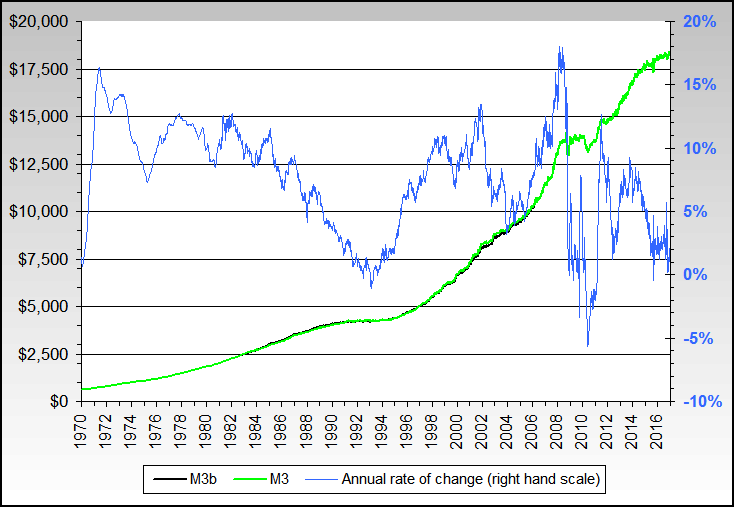
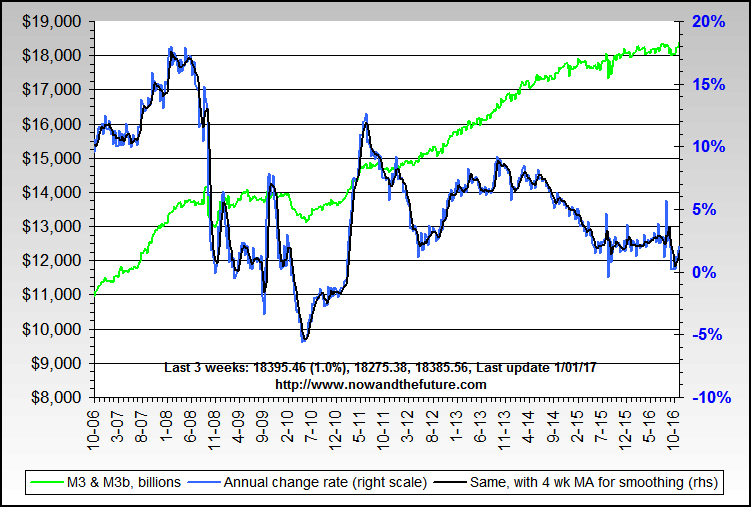
I dont really have time to explain but this is a chart of the M3 which i believe is a much more accurate measurement of inflation than the CPI produced rates that you are quoting. The problem is that the federal government stopped publishing the M3 in 2006 because they felt it was "worthless" (but who really wants to know the "total money supply") If you use the M3 our inflation rate is somewhere in the area of 16% currently.

It is easy to claim low inflation when you can spit out phony numbers yourself.


Interesting information.
 
I dont really have time to explain but this is a chart of the M3 which i believe is a much more accurate measurement of inflation than the CPI produced rates that you are quoting. The problem is that the federal government stopped publishing the M3 in 2006 because they felt it was "worthless" (but who really wants to know the "total money supply") If you use the M3 our inflation rate is somewhere in the area of 16% currently.

It is easy to claim low inflation when you can spit out phony numbers yourself.

The M3 is a measure of the money supply in the US and not a measure of inflation. The federal reserve used that as a basis to plot money available versus the GDP. They then jimmied around the prime interest rates to attempt and keep the M3 money supply close to the GDP and thus prevent inflation. The indicator itself does not measure inflation.

The CPI is the Consumer Price Index and tracks the cost of goods on the economy over time. The index is currently based upon 1982 = 100. Every month the index posts the CPI for that month. Yearly averages have remained just as I quote them. Monthly rates fluctuate greatly. The CPI can be viewed here or by browsing Department of Labor site, but it's a bit clumsy.

I went to the length of researching my post for several hours last night, please don't ever write me off as spitting out phony numbers.
 
McCain's healthcare plan, a $5000 dollar tax credit is not going to leave people enough money to purchase the best insurance considering where the premiums will go under this plan, as well people with existing conditions will no be able to switch to new providers because they would not be accepted, so the only way they see relief is to have their current premiums reduced.
Aaleel,

I didn't hit this portion of your post the first time so that I could look into where the $5,000 credit was coming from. Basically it amounts to a refund of a portion of your payroll taxes. On your W-2 you should see FICA dedutions of 7.6%. This money is taken from your gross salary much the same way that federal withholding tax is and it never enters your bank account. Your bank account only receives the net salary after taxes.

Well the FICA tax also has matching funds contributed by your employer above your gross salary which creates a net tax burden of 15.3%. Best way to view it is that the employer actually pays you 7.6% more than your current gross salary, but you don't get to keep any of it.

So between yourself and your employer a person earning $40k annually pays $6200 in FICA taxes. This is a combination of Medicare and Social Security. If Sen. McCain gave back everyone 5k he is essentially wanting to refund all or at least a sizeable chunk of the FICA tax. Now it's designed to allow you to purchase your own health plan, but unless it's one of those systems where you designate your plan and they send it there for you, it will just arrive in your pocket. Then you could spend it wherever you like.

Now, will $5k annually let you buy the best coverage available? Probably not. Will it allow you to insure yourself? Yes, for most people. Obviously anyone with a chronic illness has trouble being insured because it's not really insurance at that point, you're just purchasing treatment.

Medicare, and whatever national healthcare system that Sen. Obama wants to create, will not be the best care available either. So don't think that's so rosy either. I've been in military care for 26 years (dependent, now active duty) and it's sometimes just a "suck it up" and a prescription of 800mg Motrin. But at other times it does excell and really, you see that with any system you envision, government or private.
 
Last edited:
Well I don't have a lot of time to read and research this right now. But one thing I will say is that you're wrong about the corporate taxes. He's raising taxes on individuals making 250k, so the only small businesses that would be affected would be those where the owner files individually with his business, and out of those cases, only a small percentage make 250k.

Only problem is that people who are close would be penalized for success in a way. I'll look up the rest of the stuff when I have more time.
 
Also when I say deregulation I mean ripping apart the laws that prevented Investment banks from merging with Commercial banks and insurance companies.

Bad debt brought down companies that should have never been in that business in the first place.
 
Gregedor, I just wanted to say thanks for taking the time to post what I did not have the time/energy to research from the desert.

You are the man.

That is all.


Oh, one more thing - this is an explanation of our tax system (and why tax cuts "seem" to favor the rich) that anyone can understand:

Snopes said:
Suppose that every day, ten men go out for beer and the bill for all
ten comes to $100. If they paid their bill the way we pay our taxes, it
would go something like this:

The first four men (the poorest) would pay nothing.
The fifth would pay $1.
The sixth would pay $3.
The seventh would pay $7.
The eighth would pay $12.
The ninth would pay $18.
The tenth man (the richest) would pay $59.


So, that's what they decided to do. The ten men drank in the bar
every day and seemed quite happy with the arrangement, until one day, the
owner threw them a curve. 'Since you are all such good customers, he said,
'I'm going to reduce the cost of your daily beer by $20. Drinks for the ten
now cost just $80.

The group still wanted to pay their bill the way we pay our taxes so
the first four men were unaffected. They would still drink for free. But
what about the other six men - the paying customers? How could they divide
the $20 windfall so that everyone would get his 'fair share'? They realized
that $20 divided by six is $3.33. But if they subtracted that from
everybody's share, then the fifth man and the sixth man would each end up being paid to drink his beer. So, the bar owner
suggested that it would be fair to reduce each man's bill by roughly the
same amount, and he proceeded to work out the amounts each should pay.

And so:
The fifth man, like the first four, now paid nothing (100% savings).
The sixth now paid $2 instead of $3 (33%savings).
The seventh now paid $5 instead of $7 (28%savings).
The eighth now paid $9 instead of $12 (25% savings).
The ninth now paid $14 instead of $18 (22% savings).
The tenth now paid $49 instead of $59 (16% savings).


Each of the six was better off than before And the first four
continued to drink for free. But once outside the restaurant, the men began
to compare their savings. 'I only got a dollar out of the $20', declared the
sixth man. He pointed to the tenth man, 'but he got $10!' 'Yeah, that's
right', exclaimed the fifth man. 'I only saved a dollar, too. It's unfair
that he got ten times more than I'. 'That's true!!' shouted the seventh
man. 'Why should he get $10 back when I got only two? The wealthy get all
the breaks!' 'Wait a minute,' yelled the first four men in unison. 'We
didn't get anything at all. The system exploits the poor!'


The nine men surrounded the tenth and beat him up.


The next night the tenth man didn't show up for drinks, so the nine
sat down and had beers without him. But when it came time to pay the bill,
they discovered something important. They didn't have enough money between
all of them for even half of the bill!

And that, boys and girls, journalists and college professors, is how
our tax system works. The people who pay the highest taxes get the most
benefit from a tax reduction. Tax them too much, attack them for being
wealthy, and they just may not show up anymore. In fact, they might start
drinking overseas where the atmosphere is somewhat friendlier.

For those who understand, no explanation is needed.
For those who do not understand, no explanation is possible. ...
 
The M3 is a measure of the money supply in the US and not a measure of inflation. The federal reserve used that as a basis to plot money available versus the GDP. They then jimmied around the prime interest rates to attempt and keep the M3 money supply close to the GDP and thus prevent inflation. The indicator itself does not measure inflation.

The CPI is the Consumer Price Index and tracks the cost of goods on the economy over time. The index is currently based upon 1982 = 100. Every month the index posts the CPI for that month. Yearly averages have remained just as I quote them. Monthly rates fluctuate greatly. The CPI can be viewed here or by browsing Department of Labor site, but it's a bit clumsy.

I went to the length of researching my post for several hours last night, please don't ever write me off as spitting out phony numbers.

I am sorry if you misunderstood and thought that i was arguing against you specifically i was commenting on how the government is able to promote inflation numbers that make themselves look better. What i dont understand is how the "money supply" going up by 16% is not what we are talking about when we are asking about inflation.

The problem that i have is that CPI is a lagging indicator and it does not account for the whole of our problems.
 
The final debate was highly entertaining. McDaffy Duck went all nuts and started throwing everything he had at Bugs Bunny, who just watched him splutter with wry amusement. I half-expected him to start screaming "Rabbit season!"

mccainspleen.jpg


Definitely not a good night for McCain.
 
Last edited:
Gregedor said:
Now on to the tax statement. Financing this war is most akin to Vietnam or Korea and not WW1 or WW2. Meaning, we are not shifting a large section of our economy to production of war materials, nor are we sending troop numbers overseas in the millions. So for Vietnam the lowest personal income tax bracket went from 20% at the outset (1954-63 tax rate) to 14% by 1975 (1971-1981 tax rate). The highest tax bracket also decreased from 91% to 70%. So, both LBJ and Nixon decreased the tax rate during a war.

No, just no. You can talk about the change in tax brackets all you want to but the only question is did the overall tax burden of the country do up or down during the wars, and it went up. Taxes tripled in 1917 and reached an all time high in 1921, and didn't drop again until after the war was over. See 1916 Revenue Act. Raised tax rates and brought in an estate tax.

The tax burden went up again during WW II, there were numerous tax increases during WW II. The percentage of tax in the GDP went up double digit percents, and they also changed the minimum level of income where taxes were imposed, which caused tens of millions of more people to have to pay compared to years earlier.

Same thing happened during the Vietnam War, the overall tax burden of the country went up. I looked into this a lot. There was a Vietnam War surtax that drove up income tax 10% across the board and was retroactive. The only time the tax burden went down was in 1964 and then in spiked and didn't come down again until 1971.

Gregedor said:
But why this notion that the country cannot function with lower taxes and more money in individual's pockets? Do you know what the personal income tax rate was from 1791 to 1908? It was zero. The personal income tax did not exist until 1909. Goverment still functioned before that and managed to fight 5 major wars.

You can't compare things a century ago to now. When you're involved in trade to the extent the US is now, as well as being dependent on other countries for energy. When commodities such as oil are bought and sold no matter where they are in the world with US currency the value of our currency is very important, since other countries can buy more supply for the same amount of money we can. Also you end up paying more for your imports while getting less for your exports. People take money out of investments in the US and out them into other things. Gold has skyrocketed, as well as oil because of speculators. Before this drop in the markets Oil was no longer being controlled by supply & demand it was being controlled by investors.
 
The final debate was highly entertaining. McDaffy Duck went all nuts and started throwing everything he had at Bugs Bunny, who just watched him splutter with wry amusement. I half-expected him to start screaming "Rabbit season!"

Definitely not a good night for McCain.

I know you're a die hard Obama supporter, so I expect this opinion, but I thought McCain came out 'looking' better. I have to put that in quotes because, let's face it, Obama always looks better. He's just more polished and smooth and just gives off a more personable and confident air. McCain comes off more forced and slightly robotic, kind of suffered from the same thing Dole did in 96. If you listen to what they actually say though, Obama really never says anything. He just says stuff like how we need 'fundamental change' but never actually tells you what this change is. He is very quick to point out what we need, but very non-committal on how he'll deliver it. I saw the 'Joe Plumber' thing on the local news on Sunday night and it was a great example. The guy basically questioned Barrack on his tax plan and Obama kind of sputtered out the answer. His whole 'redistribution of wealth' scares me quite frankly. I HATE some of the stuff McCain says, but at least he says something. I dunno, last night did not help me at all. I'm still not entirely sure who I'm voting for in 3 weeks.
 
I think it was a better night for McCain in that he was more aggressive and animated, but I think it was also a worse night for McCain because he came off as petulant and angry as a result. When he finally got his chance to start slinging the mud about Ayers and ACORN stuff (without giving anyone in the audience a single clue what ACORN even means), he certainly didn't do himself any favors because he again failed to tie Obama to any of it.

Iaugh every time McCain whines that all this negativity could have been avoided if Obama had done the town hall meetings.

I was also surprised to see McCain mock the idea of a health exemption for late-term abortion bans. Putting "health of the mother" in finger-quotes really made him look like an unhinged, rightwing asshole. I know there are crusaders who believe those exemptions are gigantic loopholes -- "I have to get an abortion... what excuse should I use? I know! 'Doctor, I have a really bad hangnail. Please kill my baby.'" -- but I didn't expect to hear it coming from a guy who should know better.

And of course, he managed to contradict himself on the Roe v. Wade answer. He said he wouldn't have a litmus test for judicial appointments, but also said "I would consider anyone in their qualifications. I do not believe that someone who has supported Roe v. Wade that would be part of those qualifications." That certainly sounds like a litmus test to me.

I'm not sure how you can argue Obama never says anything, considering he lists priorities and talks about stuff he wants to do -- cutting taxes, investing in energy, health insurance, etc. It's hardly non-committal on the delivery, although I imagine the unspoken part you're missing is "Congress puts the bill together and I sign it into law." With the massive Democratic wins, he'd be in a position to deliver; McCain, in contrast, could well be facing a veto-proof Dem majority. Here's hoping, anyway.
 
Last edited:
Back
Top